Former U.S. Ambassador Jeff Flake gives remarks on soft power and diplomacy at Richard D. Heffner Open Mind Lecture

Former U.S. Ambassador to Turkey gives speech. (Photo: Gina Asprocolas/Rutgers Eagleton Institute of Politics)
Former United States Ambassador Jeff Flake spoke at the New Jersey Law Center on Cook Campus. The Eagleton Institute of Politics and the Rutgers Democracy Lab featured him on Tuesday as part of the ninth annual Richard D. Heffner Open Mind Lecture.
Ambassador Flake made the case for soft power and diplomacy on the world stage, as opposed to the current uses of hard power seen in the world involving invasions and trade sanctions. Flake defined “soft power” as a country can use to share culture, values, and foreign aid. He said it was easy to forget the virtues of diplomacy and that soft power implies controlled strength and maintains world peace. In the present day, he claims that countries involved in the BRICS organization see the United States as unreliable, but as he learned from his experiences abroad, American leadership is a choice the administration can always make.
To make his case, Ambassador Flake told the story of how he handled the tense situation regarding the Kingdom of Sweden’s application for NATO membership in 2024. Sweden could not enter the NATO alliance until the Republic of Turkey approved the application, but the Turkish President, Recep Tayyip Erdogan, did not want to sign off. At the same time, Turkey required F-16 fighter jets from the United States to stay updated to NATO standards, but the Republican congressmen in Washington did not want to sign off on that either.
Ambassador Flake had to ease tensions between the NATO allies by solving one problem with another: Flake convinced President Erdogan that if Turkey approved of Sweden’s NATO membership, then Flake would convince his fellow Republicans to finally agree to the bill giving updated military weapons to Ankara. Within twenty-four hours of the NATO agreement deadline, Erdogan finally signed his approval for Sweden’s entrance, and the signed document made its way to Washington at the last minute. Congress approved the F-16 fighter jets, and the crisis was averted. The main takeaway for Ambassador Flake was that trust is more powerful than any arms deal. He had managed to convince the politicians involved to compromise by having them trust him to do what was best for all parties. It was then he learned that the United States has a responsibility to set leadership by example, and that using soft power and diplomacy does not make a country weak in doing so.
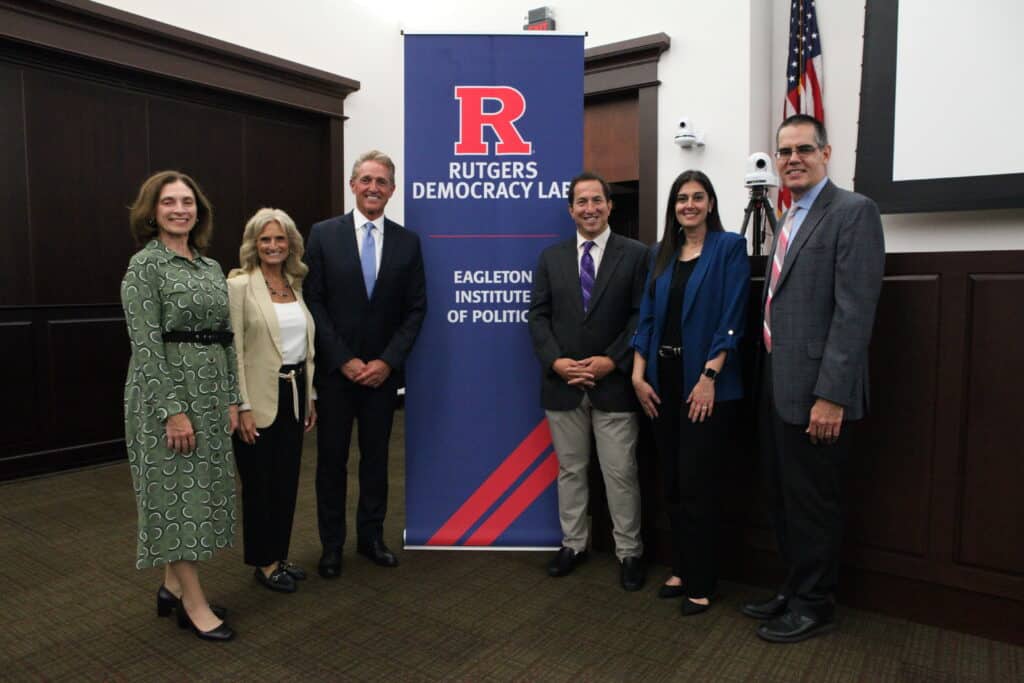
WRSU’s Maryam Malihi, Hayah Mian and Brian Chevez attended the event and connected with members of the Eagleton Undergraduate Associates Program and the Rutgers Democracy Lab, asking how they felt about Ambassador Flake’s speech.
The former U.S. ambassador to Turkey explained to WRSU’s Maryam Malihi how he learned his diplomatic values from a young age as part of his upbringing. When asked about how his childhood and religious upbringing impacted his approach to politics, Ambassador Flake replied that his primarily Mormon hometown of Snowflake, Arizona, was always governed in a bipartisan manner. To the residents of Snowflake, allegiance to a political party was designed by artificial geographic terms that were decided centuries ago. They bonded over their common allegiance to the Church of Jesus Christ of Latter-day Saints, which overrode party lines. To Flake, partisanship never meant to dislike anyone as a person, even if he disagreed with their viewpoints from time to time. He carried that bipartisan, diplomatic mentality with him as a Republican U.S. congressman from Arizona, as a U.S. senator, and finally as a U.S. ambassador advocating for connecting across borders and party lines.
Hayah Mian and Brian Chevez contributed to this story.