Ovven on Gnawing At The Cord, Solo Music, and Meme Pages

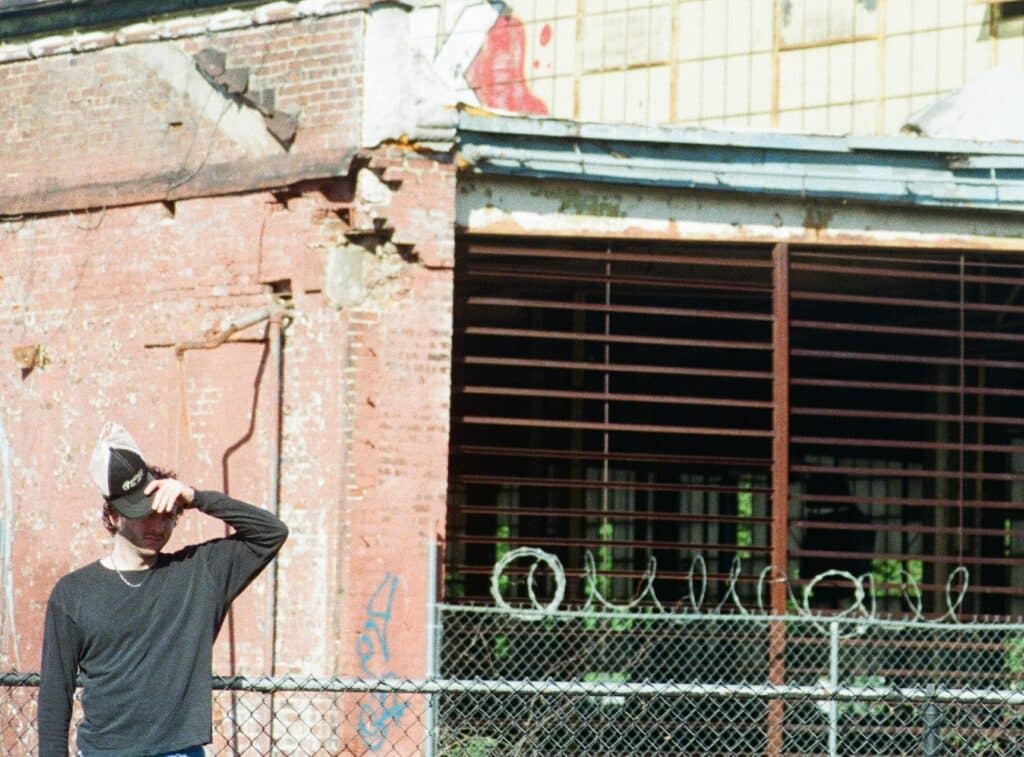
Owen Burton is Ovven. Photo: Eli Broxham
An exclusive interview with Ovven, who recently released his debut album, Gnawing At The Cord.
In Nashville, musicians must honor the legacies of greats like Hank Williams and Johnny Cash, adopt a country sound, collaborate with co-writers, and, most importantly, record at local studios. When Owen Burton moved to Music City, he knew country music customs weren’t for him.
In 2025, after a few years with the Americana band Dallas Ugly, Burton went solo under the name Ovven. His debut album, Gnawing At The Cord, is a return to his rock roots. Less twang and more guitar, he lets Nashville inspire rather than restrict. It’s a true indie rock album. “Rock music is the stuff that’s really in my bones,” Burton says.
On Gnawing At The Cord, Burton doesn’t play by the industry book. No label, no co-writers, limited country elements, a whole lot of guitar, and here’s the kicker… he recorded the album in Asheville, North Carolina. Although his approach counters Nashville tradition, things are working out – his album release show sold out, and the record is racking up thousands of streams a day.
Part of his success is thanks to his online presence. Burton uses Instagram the same way his fans do. Memes about Neil Young and videos parodying snobby music analysts litter his page, all with one purpose: to drive viewers to his music. It’s a high-effort approach with a low-key feel – a vibe most album campaigns fumble.
Calling from his Nashville home studio, Burton and I discussed fitting out as an indie rocker, working with Alex Farrar, and his marketing mindset.
Sam: Since this is your first solo album, could you introduce yourself to those who aren’t familiar with Ovven?
Owen: Ovven is my solo project, and I see it as the most rock thing I’m involved in. I’m originally from Chicago, and growing up, it was all about country music, and the Midwest was definitely looming large at that time. Then I moved to Nashville six years ago with a band I was playing in back in Chicago – an Americana project called Dallas Ugly. We’ve got two records out. Sometimes it can be a little indie rock feeling, but it’s really Americana-style music.
After we put out our second record, I wanted to make a rock record. I’ve always felt like that’s really what I know how to do. Rock music is the stuff that’s really in my bones; it’s what I grew up around. Since I’m in Nashville, I’ve mostly worked in the Americana and country world, just because that’s what a lot of the work here is.
Was it difficult to transition to rock since you’re still playing in Nashville?
Yes and no. Since the Ovven project started, I’ve gotten more connected to the indie rock scene here in Nashville, and it’s great. It’s not under the radar; it’s just not what I was connected to when I first got here. But now that I have an indie rock project, I’m getting more and more connected to it all the time.
What has it been like to receive so much attention from Gnawing At The Cord?
It’s been awesome. I’ve put out those two Dallas Ugly records, and I’ve been involved in other records in the past, and I think in the past, I’ve always put out records thinking, ‘This will be the one that people really care about.’ Gnawing At The Cord was probably the one where I’ve released enough albums by now that I’m like, “Yeah, I like it, but I don’t know if anyone else is gonna like it. Probably no one will hear it, and no one will give a fuck.”
You move on and make the next one. And then, much to my surprise, the exact opposite has happened, which has been awesome. Every day, I get a few DMs from random people being like, “Man, I just stumbled across your record, and I fucking love it.” And, yeah, that’s just been so cool.
I really made this album with the thought that no one’s ever gonna hear it. I had no marketing budget. I’m not on a label. I wasn’t well-connected in the indie scene here. Word of mouth has done a lot.
As Ovven, has your writing process changed from your time with Dallas Ugly?
In Nashville, and especially in the country and Americana world, it’s all about co-writing. People are always getting together to co-write. There are people here who are just songwriters. It seems like nobody writes songs alone in this town, like everyone has at least two or three songwriters credited on everything.
That’s never been how I work. Even with Dallas Ugly, which is highly collaborative, the songs are initially written individually, and all three band members contribute songs to the project. So it starts with one of us writing the chords, lyrics, and melody, and then we’ll kind of present it to the band as an acoustic and vocal arrangement. Then, as a band, we’ll collaborate to bring it to life.
The process for Ovven was different because these songs don’t necessarily work just as acoustic and vocals. So, to write them, try them out, and see if they could actually sustain themselves, I had to demo them myself. I would write vocals and write electric guitar riffs and stuff, and then I would record them, and I’d put a drum machine down, and then I would go ahead and add bass and kind of make a complete version of the song when I was writing it. I made a really thorough demo version of the entire album before I ever went to the studio to record it.

In the studio, you worked with Alex Farrar, who has become one of the most sought-after names in the genre. How did you connect with him?
It was just a cold call. It is a little silly to live in Nashville and then go record outside of Nashville, because there are a million studios here. But as I said, I wasn’t really connected to the indie rock scene. I was mostly aware of Alex from stuff that he had mixed – I really liked the Wild Pink album he mixed, Dulling the Horns. I love that record, and the mix on it is so good, like the guitars are super loud, but it’s not fatiguing to listen to, and then I think that’s where I first came across his name.
He also mixed Hotline TNT’s Cartwheel, and I loved that album. That’s when I was like, ‘Who is this guy?’ He mixes everything I like, and he’s produced all these other records I also like. So that’s how he ended up being my pie-in-the-sky.
I emailed the studio, Drop of Sun, and sent them demos, and was like, “Do you think I could get in this year to make the record?” They said yes, and that’s how it happened. We didn’t really do any pre-production. Alex and I had two brief phone calls before I went into the studio, and we actually met on the first day of tracking. Then we made the whole record in five days.
Did Alex’s production send your demos in a new direction?
I feel like his real influence was that he took everything across the board and elevated it. I think the demo versions of these songs all worked, and then he would just have these, like, little nuggets, or like little keyboard things that he would put on. He plays all the keyboard and piano stuff on there.
On “Abbreviated,” for example, he was like, “Something new should happen here before we jam it out at the end.” And I was like, “What do you mean?” He’s like, “I don’t know, you figure that out, but just like, it should come out a different way than it came out the first time.” I didn’t necessarily have something prepared for those kinds of directions, and I would just come up with something, you know, real quick, and then be like, let’s try this.
You’ve taken some alternative approaches to promoting and do a lot on social media. Why did you decide to go really heavy on the socials?
This is a random connection, but I’m friends with a lot of the guys in the Gavin Adcock band. Gavin is an outlaw country guy who came up independent, and he’s now one of the biggest country guys in the world.
He told me to release music all the time. I think he’s released a single every month for like, the last four years, and has never, never missed. He says, “Release more music. Don’t let anyone tell you it’s too soon to release again. Just fucking always be releasing music and thinking about what you’re releasing next, and try to go basically as fast as you can.”
He told me to hit social media hard, even though people will think it’s cringe. You do it until it works, and then, of course, once it works, everyone thinks you’re a genius. But until it works, people think you’re an idiot. That’s just how it is. If you want anyone to hear your music, that’s how you do it.
People who found me through social media are always like, “How come your music’s everywhere all of a sudden. How did this happen?” And then people who didn’t find it through social media are always like, “How come nobody knows about this?”
You post a lot of memes. I remember liking your ‘It’s all Neil Young’ meme, not knowing you posted it until I saw your album included in the post. Can you tell me about the self-promotion you do?
With the memes, I feel like there’s a real conventional wisdom around them, and maybe that means I’m doing it wrong. But the conventional wisdom is that you make fan pages and meme accounts that you’re actually running, but they’re not your main account. That way, no one thinks it’s self-promotion, even though you are self-promoting; you’re just doing it from basically a fake account.
I guess that makes sense to me. Certainly, some people see my memes, and then they’re just like, “Screw this guy for his self-promotion.” But if you’re trying to bring in new people, I think the most helpful thing you can do is make a post that succinctly gives the fans context to understand the music. So with the ‘It’s all Neil Young’ meme, it’s me saying, “Hey, I think my music is on this big vibrant tree of stuff that is all descended from this sound.”
The fact that it’s done in a humorous way is intended to encourage people to send it to their friends because it’s funny. If you’re putting music out that is targeted toward people who have no idea who you are, you have to do it in a way that gives them context.
Humor is very much a part of indie rock songwriting. How does humor influence your process?
I try to make music that feels like how the world feels to me. That’s always kind of funny and kind of sad at the same time. A lot of the funny stuff that’s in my lyrics is direct quotes, usually just from my friends, just funny things my friends have said, where I’m just like, damn, there’s so much truth in that joke. And it’s so much truth that I want to make it a lyric.
How have contemporary artists like MJ and Wednesday influenced you? Not just in terms of music, but also approaching the indie scene?
MJ and Wednesday are definitely huge influences for me. Both of them seem to have transcended the genre, which is awesome to see. In the country scene, where I also work, there is a tradition of borrowing from other artists or even explicitly referencing other artists in your music. MJ and Wednesday always have these things in their music that are explicitly referential.
There’s that Wednesday song, “The Way Love Goes.” I think a lot of Wednesday fans might not know that that’s 95% a Merle Haggard song of the same title. I wouldn’t call it a cover, because she’s singing different words and sometimes the chords are different, but it’s really a Merle Haggard song, which is so cool.
I felt like it kind of gave me permission not to be afraid of being a little referential in stuff that I consider rock music. In my mind, that hasn’t been part of the tradition the way it has been in country, but MJ and Wednesday are doing it, and they’re doing it so well that I was like, I should be less afraid of this.
In terms of non-contemporary music, who are your influences from the ‘90s and beyond?
Growing up, Wilco was my favorite band, for sure. Being from Chicago and growing up at that time, for people who knew about them, they were the biggest band in the world. It was like you were either the coolest band in the world or you had no idea who they were. That got me into Son Volt and Uncle Tupelo, the whole Wilco universe.
The Tweedy-verse.
Yeah, then in elementary school, I read this book on The Replacements, and I thought they were really cool. I love the story about how they broke up on stage at Taste of Chicago.
Also, Lucinda Williams – she’s sometimes left out of that conversation, but she’s definitely one of my old country heroes. Car Wheels On A Gravel Road is one of the biggest influences on my guitar playing.
What’s your favorite Wilco album?
Summerteeth. It always feels to me like an American band trying to make a Beatles record.
That’s a good way to put it.
Dare I use the word twang? There’s something in Summerteeth where you can tell that this is an American band doing this. It feels very influenced by the late Beatles stuff.
But, I love A.M. – that’s in my alt country Mount Rushmore for sure. I mean, I like the early stuff, and Yankee Hotel was my favorite Wilco record in high school.
That is a very high school, ‘this is as good as it gets for indie rock’ sort of thing.
Here’s a joke, but it’s true. It was like when I was in high school, I didn’t like Radiohead because only the most pretentious a**hole dudes I knew liked them, so I couldn’t even fathom liking them myself. But I just ended up loving Yankee Hotel Foxtrot instead of being into Radiohead.
Now I love Radiohead. Only in the last year or two have I been like, “I should actually listen to Radiohead for the first time.” I listened to it, and was like, “Yeah, this shit is awesome.”
You recently played an album release show in Nashville. Are there plans for a tour?
I’ve only ever played locally here in Nashville, and a challenge of being a solo artist is that it doesn’t really make sense to play this music solo, so I have to hire a full band every time I play. But all of my friends are professional musicians, so it’s like I get to just hire them and play music with them. It was nearly an all-new band, all friends of mine who hadn’t played with me yet. Plus, it sold out, which was crazy to me. So it definitely gave me a little bit of confidence, like, “Maybe I should tour this project a little bit.”
In June, I’m playing Richmond, New York, and Boston, and then trying to fill in one or two more dates, but those three are already locked in. As far as touring, the plan I’m following is to do the smallest rock clubs in all of those towns, try to sell them out, and then once you’ve done that, you’ve really proved you have some staying power.
This interview has been condensed and edited from a longer conversation.
Ovven’s debut album, Gnawing At The Cord, is out now. Find tickets to his tour dates here.