Charli XCX’s Music Fashion Film Tour Is a Celebration of Everything That Doesn’t Last
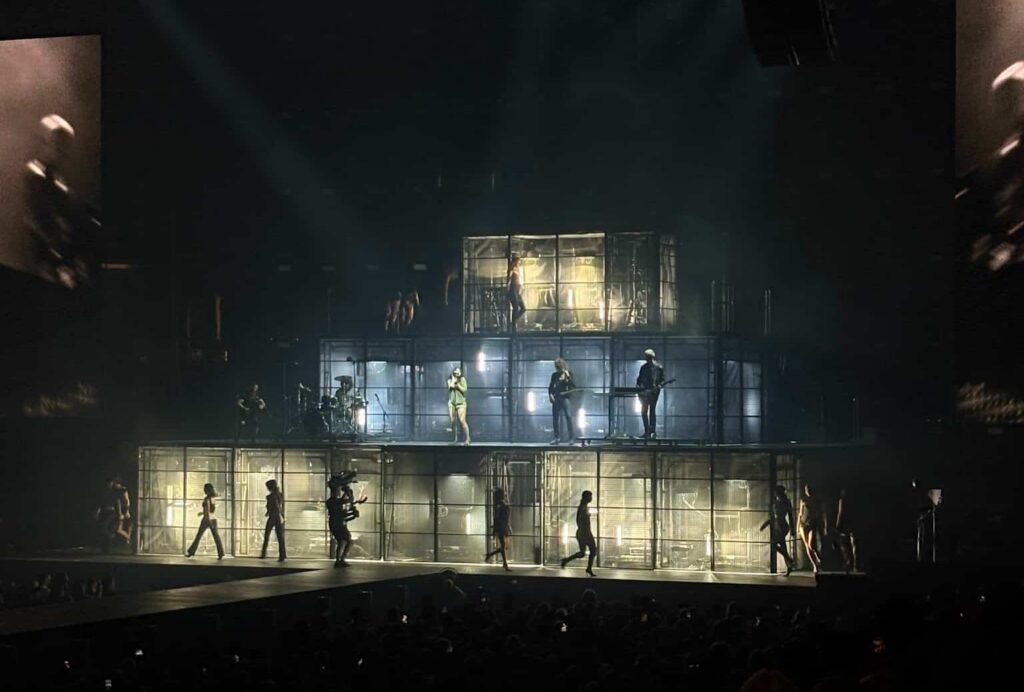
Charli XCX performing at the Barclays Center
Words and photos by Spencer Van Goor
Sometimes a concert is more than just a performance; it’s a statement. Charli XCX’s Music, Fashion, Film Tour was exactly that.
Inside the Barclays Center last Tuesday, Charli transformed an arena into a film set, a nightclub, a fashion show, and a basement rave. Four brutalist black metal structures occupied the stage, each functioning as its own lighting fixture and architectural centerpiece. Strobes, pyrotechnics, and fireworks turned the otherwise stark scene into a constantly shifting environment. Maximalist without feeling excessive, with every visual serving the larger world Charli constructed.
She opens with “Rock Music,” the lead single released from Music, Fashion, Film. The distorted guitars and abrasive energy established a rawness that would continually collide with the polished spectacle of this tour.
Following “Girl, so confusing feat. Lorde,” the first beat of “pink diamond” detonated through Barclays as the entire stage transformed around it. Nearly five years after she last performed it on the How I’m Feeling Now Tour, the song felt like a reminder of just how much Charli’s sound has shifted since 2014’s Sucker. Her career has moved through glossy pop, hyperpop, underground experimentation, club music, maximalism, and the cultural phenomenon of Brat, but the Music, Fashion, Film Tour refuses to treat these eras as separate chapters. Instead, they bleed into one another, forming a portrait of an artist still evolving and growing.
“Apple” melts into “Wink Wink.” “Dying for You” gradually becomes “Club classics,” before the latter gives way to “365.” Later, “2007” becomes intertwined with “Camera,” eventually evolving into “party 4 u.” Even “pink diamond” contains elements of “No One Lasts Forever,” a pinnacle song of this entire era. The result is an amalgamation of Charli’s discography.
In that sense, Music, Fashion, Film is less concerned with where Charli has been than with what happens when all of those versions of Charli exist simultaneously. Music, fashion, and film aren’t presented as three separate interests. They are three transformative languages for building up and breaking down the same persona.
Charli is a rock star in certain songs like “Rock Music” and “Wink Wink,” playing directly to the live-stream cameras that project her image onto the arena’s larger screens. At other points, she’s a model walking down a runway, like in “SS26” and “Card Declined.”

The Music, Fashion, Film era is obsessed with the tension between celebrity and ordinary life, individuality and conformity, artistic expression and commercialization. Charli’s always avoided genre classification, yet she’s one of the most recognizable figures in contemporary pop. What happens when the underground becomes mainstream? What happens when individuality becomes an aesthetic that thousands of people can reproduce?
The Brooklyn crowd offered an answer: they produced it together. Ripped white tees, heavy eyeliner, studs, leather, and a specifically grungy sexuality filled the arena. But the crowd didn’t feel like thousands of people individually cosplaying Charli. It felt like a community sharing a moment in time.
The communal energy was especially apparent during the night’s surprise songs. When Charli dropped the opening beat of “Roll With Me,” the entire arena erupted, just as it had earlier for “Next Level Charli.” Hearing these songs alongside “Vroom Vroom” and the rest of the set made them feel less like nostalgia and more like pieces of Charli’s history being pulled into the present. Songs that once represented the future of her sound now exist as part of a career she continues to reinterpret and reinvent.
This is perhaps what makes the show such a convincing celebration of her body of work. Charli doesn’t seem interested in proving that one era was better than another; she treats every era as material.
The show’s emotional trajectory mirrors this tension, beginning with the high-energy, cynical dazzle of public persona and consumption before gradually revealing something more vulnerable underneath. As the spectacle turns toward burnout, identity, and criticism, “Playboy Bunny” complicates the pressure to reinvent oneself constantly: Charli can change her sound, clothes, and public image, but every new version still has to coexist within the same person. Reinvention becomes both a source of artistic freedom and a trap, especially when the expectation is that an artist must always become something new.

And then, the finale comes with “No One Lasts Forever feat. David Cronenberg.”
Charli ends the show standing frozen within a vignette of dancers, all staring out in a kind of surreal stillness. After nearly two hours of relentless movement, flashing lights, screaming fans, and songs bleeding into one another, the show stops trying to impress and becomes nearly mournful.
This stunning ending, reflecting acceptance of impermanence, hits especially hard because it doesn’t resolve the contradictions that came before. Nothing lasts forever: not a hit song, not a fashion trend, not a tour, not an era, not even the version of yourself that you spent years constructing.
But that doesn’t make any of it meaningless.
For Charli, the opposite seems true. The eras matter because they happened. The songs matter because they meant something when she made them. The fact that they will eventually become old doesn’t diminish them; it makes their existence more significant.
The thesis is almost deceptively simple: nothing lasts forever. The music doesn’t. The clothes don’t. The fame doesn’t. The versions of Charli that we think we know don’t.
So why not make something worth experiencing while it exists?