Greg Freeman on his New Album, Recording Economically, and White Boy Indie Rock
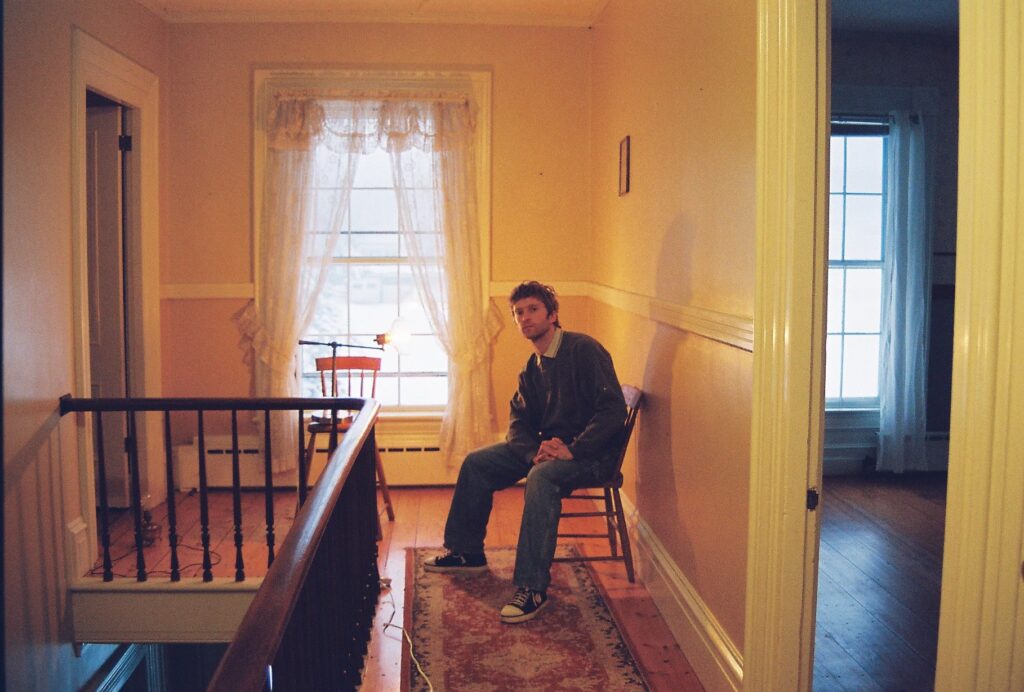
Greg Freeman
In one of his first interviews of 2026, Greg Freeman discussed what’s next for him and reflected on his songwriting.
It’s the first comfortable day of summer. After weeks of brutal East Coast heat, the sun’s eased and a Silver Jews lyric rings in my head, “It’s sunny and 75, it feels so good to be alive.” While appreciating this modest June morning, I hop on a Zoom with Burlington rocker, Greg Freeman.
He’s taking a walk near his Vermont home, enjoying a hushed break after dropping his car at the shop. Later in the week, he’ll perform new material with a band he’s never played live with, but that doesn’t seem to bother him. For now, minimal errands and rest top his Monday to-do list. His camera is off, but it’s easy to picture Freeman in this setting. His most recent album, Burnover, captured quotidian moments like these.
The follow-up to his vicious debut, I Looked Out, Burnover sheds his prior angst, allowing his lyricism to breathe. Because mixing was out of Freeman’s hands on Burnover, songwriting became the priority. Like a Silver Jews song, Freeman’s lyrics wrap around the listener without resistance. He sings about real life with distant glimpses begging for binoculars. Pine box hills, gallic shrugs, and Valentine’s Day parades, each a vision that becomes rock scripture. Rather than double-dipping into guitar solos and prolonged instrumental breaks, his vocals are restless like a door-to-door salesman retreating home after a soulless day. Similar to Ryan Davis, his songs fear a finale, building upon their stories until there’s nothing left to say.
Although I joined the call ready to talk Burnover, his sophomore record was already in the rearview. During his tour with Grandaddy last fall, he started piecing together LP3. Once his January tour wrapped, he ventured West and recorded the new album in California. “It’s heavy and fast, and there’s a lot of improv instrumental bits,” Freeman told me about the record without revealing any label-locked secrets. While recording the album, Freeman wrote economically. After years of touring with five or six additional members, he stripped the band back. Maybe money was on his mind, but he saw the record as a time to try a “traditional” approach.
Freeman also sees LP3 as an opportunity to break from the country rock genre to which he’s typically categorized. He doesn’t see any issues with the MJ Lenderman archetype, but that doesn’t mean Freeman wants to be a PR model of alternative rock. He’s wary of the country mark specifically: “Alt-country feels like a very specific sub-genre that doesn’t capture what my music is,” he told me.
While on a walk in his hometown, Freeman dove into his songwriting style, avoiding inspiration from the classics, and what’s next for the [insert genre here] musician.
Sam: You’ve stayed pretty under the radar this year. What has the year looked like so far?
Greg Freeman: Well, I recorded a new album in California. I don’t know when it’s gonna be announced, but soon. In between touring Burnover, I was writing these songs, fleshing them out, and preparing to record the new album.
I’ve been doing that, and just chilling in Vermont. Green River Fest is coming this week, then the UK tour in August, and we’re actually only playing new songs at Green River.
Without giving too much away, can you tell me a little bit about the new album?
I wanted to do an album that feels as live as possible. The last two albums were partially live, but they had a lot of overdubbing on top of the foundation we originally recorded. For this album, I wanted you to hear the band and have it be a real artifact of a moment. We did more practicing for it than the last two albums, and it’s a different band than my previous touring/recording band, so it’s pretty different.
It’s heavy and fast, and there’s a lot of improv instrumental bits, so it covers the full spectrum of what I was trying to achieve with the last two albums that I never fully figured out until now. Or, I don’t know, the time or the resources to like actualize.
That’s very exciting. WRSU loved Burnover, so we can’t wait for what’s next. Could you tell me about your songwriting approach on Burnover?
I produced that record, but I recorded it at my friend’s studio, and it was largely out of my hands in terms of mixing, and it wasn’t like I Looked Out, where I had unlimited time to mess with it, and put all my little sonic touches on everything, and experiment. So, I feel like the part of Burnover I spent the most time on was songwriting.
I did a lot of revising and tried to remove anything that felt unnecessary. I just wanted it to be compact in its lyricalness. I feel like it gave me more parameters for the overlapping themes on that record. It helped me narrow my focus, maybe in terms of metaphors and imagery.
Outside of music, what were you influenced by that made its way onto the songs?
There’s so much visual imagery on that record, and it’s just pulled from everyday life. Things I read, or in books, and things I saw on TV and in movies. When I think about my music, I see some kind of reflection of my personal life.
There’s a lot of thinking about where I live, and working through my relationship with where I live. I still live in Vermont, but I was moving around a bit while I was working on Burnover. I was trying to make sense of my place here and whether I want to stay here forever or move somewhere else.
The ‘letting every day things influence me’ approach is a very college-creative-writing-class method. Do you do any forms of writing outside of songwriting?
I’m trying to get better at writing poems. I don’t think I could do anything that’s a larger format than poems, maybe short stories one day, but a song is hard enough. You have so much liberty with song lyrics, where you can, depending on how you sing it, make something that doesn’t actually mean anything, mean a lot. Writing is so hard, like fiction and any kind of writing that isn’t lyric writing, but I’m trying to get better at poems.
Songwriting is what makes sense to me, in terms of being able to make meaning out of an idea. There are so many limitations, I guess, in terms of writing lyrics that a poem is such a blank slate, it’s kind of intimidating in that way.
Who are the artists that you take influence from in terms of songwriting?
I keep coming back to Elvis Costello and Paul Westerberg, and honestly, MF DOOM. I’ve been listening to a lot of people who have a real, I don’t know, eccentric style of rhyming, and a very clear vision of what they’re doing.
But, I mean, all the classics too. Jason Molina, Neil Young, and Bob Dylan are all just baked into anyone who’s making the type of music that I’m making, but I don’t actually look towards them for that much lyrical inspiration right now. It may be a thing of wanting to steer clear of things that you’re compared to too much.
But in general, I’ve been drawn to someone like Elvis Costello, who’s just so eccentric, and I’m like, ‘What is he even talking about, you know?’ There’s so many lyrics, there’s so much imagery, it’s so overflowing. But, rap music too. It’s just poetry, you know? It’s the most stimulating music to listen to when you’re thinking about lyrics. I feel like it’s Silver Jews, and then like all of rap music, in terms of just pure music, just about the lyricism.
It’s interesting to hear rap brought up because over the last few years, there’s been so much discourse over ‘alt-country,’ and the ‘new country rock wave,’ and your name is often grouped into those borders. How do you kind of feel about that grouping? What are your thoughts on genre in general?
I don’t feel like I hear alt-country when I hear my music. In the same way that you wouldn’t say Sparklehorse is alt-country, there are too many influences going into it. Alt-country feels like a very specific subgenre that doesn’t capture what my music is. Not to say it’s beneath me or anything. I think genre, at this point, is mostly for PR people who aren’t good writers and want to lean on comparisons.
I guess there are a lot of country-kind-of bands that have popped up, but I always feel like there’s not as much of that music as there is made out to be. I don’t actually really hear that many bands that sound like MJ Lenderman or whatever out in the wild. I guess you can find anything on streaming, but I don’t know, I would like to exist outside some niche subgenre of white boy indie rock. But I know that you can’t always choose what happens to your perception.
I’ve seen you play live a few times, and I’m always blown away by how full of sound you guys create. I imagine part of that is due to having a 6-piece band. Has it always been important to you to tour with so many people and include so many instruments?
I never even really thought about it that way, but now I have to, because it’s my job to tour, and money is a more pressing issue. But up until now, I always had the luxury of just having friends who wanted to play the songs with me and go on tour. I mean, my first tour I did for I Looked Out was with seven people. I never even thought of that as a thing, like doing a thing, it was just kind of like there are two horns, and they harmonize with each other, and there are two guitars, and they do different things, and then there’s obviously bass and drums and maybe pedal steel too.
I wanted to represent the songs fairly with a full sound, but my new record that’s coming out is definitely more traditional. Two guitars, keyboard, drums, and bass. So I’m trying to reel it in and be economical going forward.
Will the Green River show be the new band?
The Green River show is interesting because it’s going to be the band that recorded that new album.
So it’s not really a full-time touring band, and I think this is probably the only show that we’re gonna do that’s that exact group of people.
Your live arrangements can sound very different from the studio recordings. Before a tour, do you practice a specific approach, or is it more loose and jam band-like?
Everyone has their parts that they’ve come up with over the years of touring, and some of those parts differ from the record. Because everyone in that touring band for the last two albums was playing different instruments, there was no clashing between instruments. Everyone could do their thing and be as loose or as tight as they want, and they’ll still exist in their own realms.
In my mind, we’re pretty loose a lot of the time, but then you hear recordings, and it’s actually really tight, so I don’t even know. People are always saying things are loose or things are tight, and it doesn’t mean anything to me.
Last fall, you opened for indie rock legends, Grandaddy. Were there any lessons or skills you picked up?
The main thing was that if you do your thing for long enough, people will stand by your music for decades if you have integrity and do your own thing and don’t compromise and stuff. They have such a great fan base, and they’re obviously legends, but I didn’t know that they’d be able to sell out rooms that big, like, immediately.
What was the first song you remember hearing on the radio?
Holy shit. Oh, wow, I don’t, I have no idea. I remember the first song I downloaded to an MP3 player was “Smack That” by Akon and Eminem.
My earliest radio memories are my dad playing baseball on AM radio, and I would be really car sick in the back of his sweaty car.
Fair enough, I think we’ve all been there. And, if you were to create a three-song segment for a college radio show, what would you pick?
I’ve been listening to the band His Name Is Alive a lot. So, I’d played their song called “The Dirt Eaters.” I’d play “Saliva” by Victor Vaughn, aka MF DOOM, and I’d play “Do You Like Me” by Fugazi.
Greg Freeman begins his Europe tour this August. Find tickets and more information on Greg Freeman here.