Radio Free Alice on their Debut Album, Indie Rock Legends, and Touring
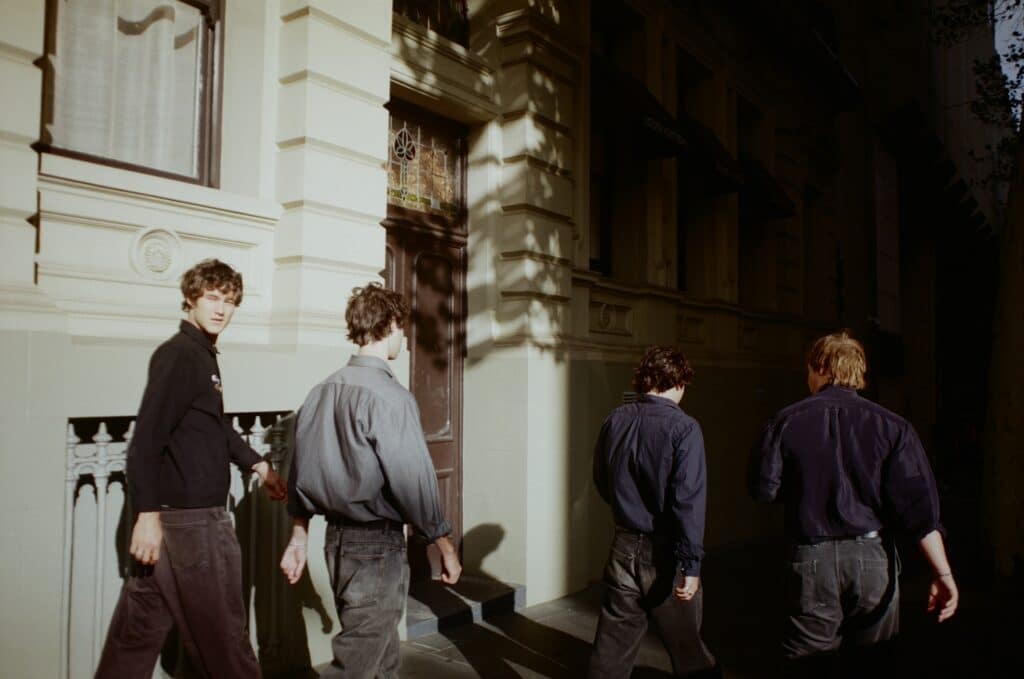
Noah Learmonth of Radio Free Alice. Photo: Harry Baker
For Noah Learmonth, music began with punk rock. Once Learmonth, frontman of Radio Free Alice, latched onto the nervousness of early UK punk, he hasn’t looked back.
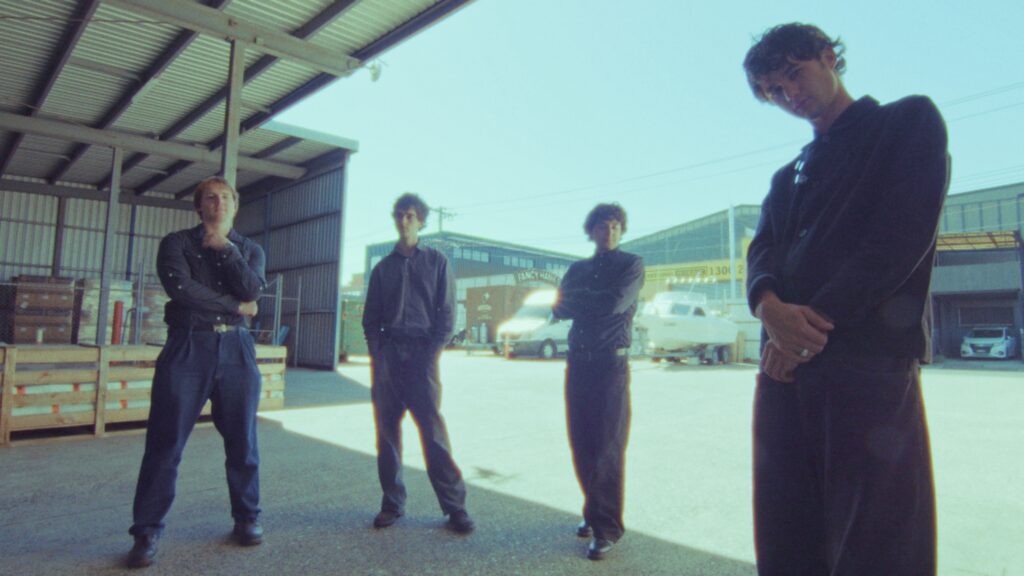
Three EPs in three years, Melbourne-bred Radio Free Alice is a reverberant new voice of the post-punk revival. Following the rise of bands like Fontaines D.C. and Wet Leg, RFA found their niche as an Aussie band with grizzled riffs and blunt lyrics. Their self-titled debut EP became an instant hit in indie circles and earned them supporting slots for The Killers and Royel Otis. In 2025, they toured the U.S. for the first time, selling out multiple nights in NYC. While on the road, they worked on their long-awaited debut album, set for release later this year.
With Learmonth at the helm, RFA’s debut is in the hands of a rock scholar. When he needs inspiration, he turns to the classics—bands like The Smiths, Strokes, Bettie Serveert, and R.E.M. constitute his musical vocabulary. When asked which landmark bands he pulls from, he paused for over a minute because too many bands ran through his head. Every RFA cut is an inflection of his influences; their newest track, “Rule 31,” manipulates Learmonth’s essentials and undergoes his turbulent spell.
As much as Learmonth values the music of the past, he is focused on keeping new music relevant and bringing new generations into the fold. In an age when anyone can stream the last century of rock, he keeps it fresh. “You’re no longer just competing with your contemporaries; you’re competing with the history of your genre,” he says.
Before their upcoming Australia tour with Geese, Learmonth spoke with me about their debut album, the legacy of indie rock, and Cameron Winter memes.
You’re currently recording your debut album. How is that process going?
It’s good, we kind of just started. We already recorded a few songs for the album with a guy in Connecticut named Peter Katis. We’re recording another nine songs here, so I don’t have a huge amount to say about it. But yeah, there’s some slight time pressure, because we’ve got basically three weeks to do nine songs, which is about a song every two days. It’s doable, but we’re gonna have to focus.
Is Peter producing the rest of the stuff you’re doing in Australia?
No, we have a different guy called Ewan Pearson, who we worked with before. He produced a song we did called “Empty Words” a while ago.
What’s it like to have a few songs in the tank and then record in a different place? I don’t know if Connecticut and Australia could be any more different.
I just hope the songs we recorded with Peter won’t stick out too much. Peter has his own style, so I hope they won’t sound too obviously different.
I read that Fontaines D.C. and MJ Lenderman were big inspirations for the last EP. Did that continue with the new album?
Well, we kind of all listen to our own stuff. We don’t have group listening parties or anything like that. But, yeah, I still like Fontaines and MJ, but I listen to a lot of older music. I went through a period of listening exclusively to current music, and more recently, I’ve come to accept that it’s just so difficult to compete with the canon of great indie rock. I almost felt like I wanted to support my generation of music, which I believe in to an extent, but also, R.E.M. is just too good.
Let’s go through the lineage of indie rock. Where is the beginning for you? Do you start with punk rock or The Zombies in the ’60s?
Good question. I wouldn’t go as far back as the ’60s. I’m sort of anti-psych and hippie stuff.
The earliest back I would go is late ’70s punk. For me, that’s kind of when music started. It was late ’70s punk, and then the music that came out of that–post punk and new wave. From then on, it’s all really interesting to me. But, I would say late ’70s punk is probably as old as I get.
Which side of punk are you into more? UK or U.S.?
Both, but probably UK. I mean, I love American music so much, but generally, there is a tone to British music, a kind of nervousness, that I find really interesting.
What are the ‘80s bands that you always go back to?
It’s the classics like The Smiths and The Cure.
I love Elvis Costello. I love [pauses] early Devo, also early Tears for Fears.
What about ‘90s bands?
It’s tough to answer that, because almost everything I listen to is ’80s and ’90s. I’m trying to almost narrow it down in my head. There’s a band I really like called Bettie Serveert.
Are they indie rock?
They’re late ’90s indie rock. They’re a Scandinavian band that never quite got the love that they deserve. They’re amazing. But other than that, R.E.M., Pixies, and Sonic Youth. [pauses] God, I’m just trying to think of bands that I like. This is kind of one of those questions where I feel like I should be rallying them off more easily.
After touring heavily in 2025, how has it been to have a break?
There are certain things that I really miss while on tour. I miss simple things, like waking up in my bedroom, and there’s a local pool that I really like to swim laps in. Also, hanging out with friends who are outside of the band, and don’t really give a f*** about the band. It gives you a sense that your music career is not the whole world, because it can feel that way when you’re on tour. It can feel like this is really ride-or-die, and then you realize, like, ‘Oh, the world’s still spinning regardless of what’s going on in indie rock.’
When you came to America, did you find a level of interest and engagement that differed from what you had in Australia or the UK?
Yeah, it’s interesting. I mean, we’ve been warned of that. We kind of knew that was going to happen. But we’ve toured the UK and Europe before, which was sick, and this time we went straight from the UK, where it was pumping, to America, where it felt like three steps backwards in terms of turnout.
We kind of knew that was a thing, even based on Spotify numbers. We’re not getting that many listens in Nashville; we knew that going in, but it’s still cool. America is such an interesting country; we’re keen to spend more time there and keep doing our thing over there.
Speaking of touring, RFA is opening for Geese in Australia in a few weeks. Are you looking forward to those shows?
Yeah, I’m looking forward to meeting them. My Instagram algorithm is so f***ing filled with Geese memes; they’re almost the only thing I see anymore. I feel like I’m gonna have a weird mind f*** where I’m looking at Cameron Winter’s face. Because I’ve seen his face in the context of so many memes, and I’ll actually be looking at it, like, is it real? [laughs].
That’s exactly how my feed is, too. All I see is discourse and videos about Geese. The whole situation says something about where the music industry is at in terms of its relationship with social media. How do you feel about Instagram and TikTok playing a big role in how music gets out there now?
I don’t really care, as long as I don’t have to be the one who’s posting. If our success is the result of people posting stuff about us on Instagram, then I don’t mind. I don’t think Instagram as a platform, or gaining popularity via Instagram or TikTok, destroys credibility. If the music’s good, the music’s good, it’s just another platform.
If you do become a successful musician by twerking on Instagram, then that’s problematic. But, I’m pessimistic about the state of the music industry, to the extent that I’m pessimistic about the state of the world, like, it’s all f***ed. The music industry is f***ed, in a sense, but only to the extent that everything else is f***ed.
Do you think you’ve positioned yourself in a place to succeed in the industry?
The fact that we’ve gotten this far and haven’t had to do any reels or any kind of speaking to the camera makes me think, ‘Maybe we will never have to do that.’ Which is exciting because it can be done. When the music is great, it can take on a life of its own.
The Geese thing is interesting for a few reasons. One is that the frenzy around them has this sort of obsessive, frothing-at-the-mouth that’s going on. The reason is that there has been such a deficit of great music, particularly great indie rock. And finally, there’s a band that’s pretty great, and people are just losing their minds. It shows that there is a real appetite for that.
Music, particularly indie rock, went through a dead period throughout the 2010s. But the reason for that, I don’t think, was necessarily a loss of interest in rock music or guitar music; I think it was just that there wasn’t that much good music. In my experience, when you ask people, ‘What’s your favorite kind of music?’ The answer is guitar music.
The appetite is still very much there. It’s just so much s*** is not that good. It’s just not good enough. It can’t compete with the canon of great music. The issue or the great thing about how people listen to music via Spotify today is that the history of music is there with a click of a button. You’ve got 100 years of great guitar music. But the thing about that is, if you’ve got 100 years’ worth of great guitar music, you’re disincentivized to listen to current guitar music, so they decide to compete.
You’re no longer just competing with your contemporaries; you’re competing with the history of your genre. So the bar is set higher. I think that’s largely why people don’t listen to as much contemporary music. A band like Geese or Fontaines holds up against the canon of The Smiths or The Fall. The possibility of success for an indie rock band is there, and has always been there; it’s just that the bar is so high, but it can be done.
Yeah, that’s really well put. I’ve written a lot about Geese and how they emerged from a period of such dry, redundant music. Music can be repetitive, but it still needs to be good.
Yeah, totally. You can be unoriginal as long as it’s at least catchy. So much music in the past 15 years isn’t original, and it’s not even fun. You can be original and bad, too. You can be at least one of the two, ideally, original and good. But if you’re neither, that’s f***ed.
Radio Free Alice have released an EP every year over the last three years. With the debut album coming up, are you excited to do a long-form project for the first time?
Yeah, definitely, because last year was the time that really made sense to put out the first album, but for sort of circumstantial reasons, we couldn’t. So, it feels a bit overdue, but I’m excited. The fact that we were forced to wait so long is cool, too, because we feel very ready. We have a lot of reverence for bands that had really awesome first albums. So, it’s so important to us that this is a really great album.
What are the debut albums that inspire you?
The Strokes is classic in that respect. I love The Clash’s self-titled record. Even Fontaine’s first album, we all love.
Do you feel more pressure now that it’s an album release rather than an EP or single?
I would feel pressure if I were stressed about not having enough good songs. The thing about the EP that’s nice is it’s only four songs, so it’s easy to write. If you have a year to write four good songs, that’s a pretty easy thing to do, but 12 songs is a bit harder. But I’m proud to say that there are no weak filler songs.
Every song on the record is really special, and we’ve been compiling these songs for ages now. We have saved songs from a while back for the album. What I’m trying to say is we’ve had a long time to write the album, and I don’t feel pressure because I’m pretty confident that we’ve got it.
Is it sonically similar to the last few EPS, or is it moving towards something new?
It’s eclectic. That’s the one thing about it that I do like, it’s very eclectic. On one end, you’ve got indie punk banger vibe, and then you’ve got slow, kind of Lou Reed Coney Island Baby vibe. It’s just very broad.
It covers all ends of the spectrum. It brings something from the music we’ve released, but then also brings some new stuff to the table. There’s some more acoustic stuff, some more down-tempo stuff. Initially, we were like, ‘Shit, I think there are too many slow songs.’ We’ve kind of built a brand up on more high-energy music, and we’re going, ‘Shit, we’ve got an album of ballads.’ But that’s not really the case anymore.
In June, you’re playing Gov Ball. Are you looking forward to coming back to the city?
Yeah, we love New York, and America’s such a weird but fascinating country. I kind of want to spend as much time there as I can, particularly now. But yeah, I’m excited.
It’s a very interesting time to be here.
I’ve been told Gov Ball is a big deal for New Yorkers, but I wasn’t really aware of it before we got the nod for it.
Before you go, can you make me a three-song segment for my radio show?
Okay, well, there’s a really great music scene in Melbourne, so I’ll rep a few songs from some of our mates. Let’s do, “New York, Paris, and London” by HighSchool. “Italy” by Raindogs. And “Abyssal” by Shock Corridor.
“Rule 31” by Radio Free Alice is available now. Learn more about Radio Free Alice, here.