
NJPIRG Students hold press conference on automatic textbook billing
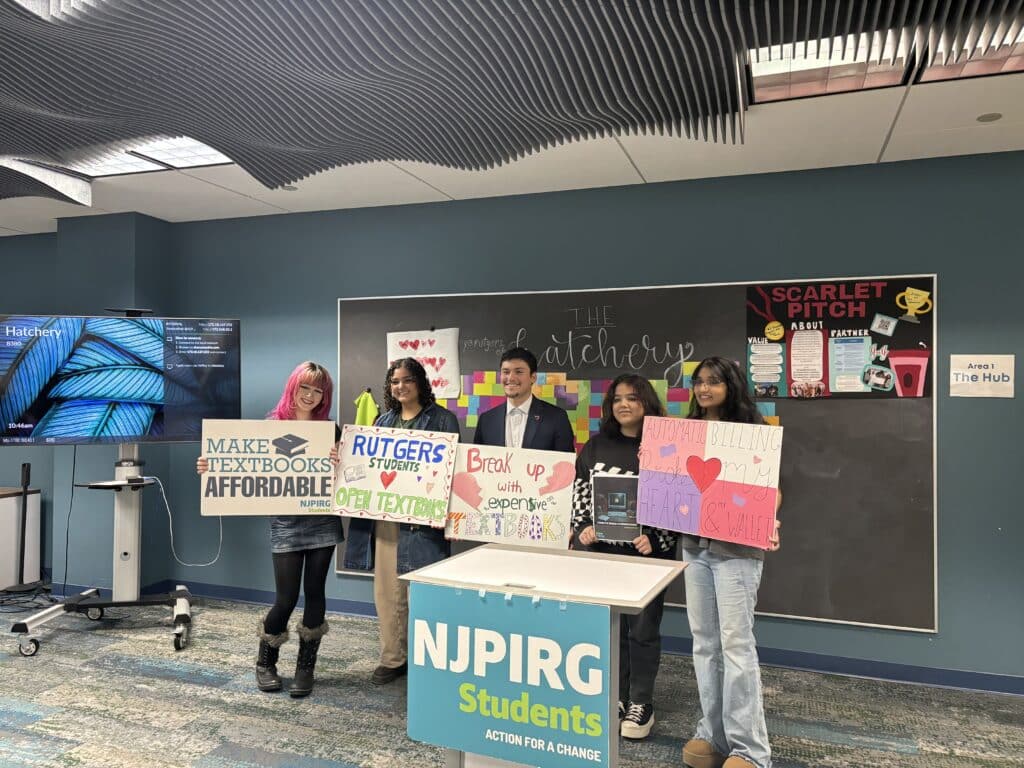
Students at the NJPIRG press conference holding signs to support the open textbooks initiative. | Photo: Keya Raval
The New Jersey Student Public Interest Research groups released their fourth edition of their report titled “Fixing the Broken Textbook Market” on Tuesday, accompanied by a press conference at the Hatchery in Alexander Library.
Over 4000 students across 110 universities were surveyed for the report, which covered the negative student experiences with inclusive access billing programs and access codes as students struggle to afford the high costs of textbooks.
Key findings included that access codes have become mandatory for completing coursework, automatic billing programs charge students without their consent, and that the cost of course materials directly affects students’ academic success and daily lives in a negative manner.
Student speakers, including Rutgers Student Body President Christopher Godoy, spoke on their experiences with textbook affordability. “At Rutgers, 1-in-3 students experience food insecurity, meaning that thousands of students on our campus have faced the choice of spending their hard-earned money on food, supplies they need to survive, or textbooks they need (sometimes required) to excel in class. This should never be a question students ask themselves.”
Godoy added that RUSA aims to coordinate with the University Senate and NJPIRG to advocate for solutions to high textbook costs, as “affordability is at the top of students’ minds.”
Chris Wu, a senior working with Rutgers NJPIRG, said that they were inspired to advocate for the open textbook initiative because of how widespread the affordability issue is. “This is something that affects so many students, and affects them very greatly actually. I know that myself, I’ve been affected by how much textbooks cost. I’ve seen that a lot of my peers are unable to afford the textbooks and actually have to drop out of some of the classes. It makes it really bad for everybody and it should be changed.”
Rutgers librarian Rhonda Marker and psychology assistant teaching professor Stephen Kilianski both spoke about initiatives for open textbooks on the faculty and administration’s end.
The Open and Affordable Textbooks Program has saved Rutgers students over $13 million to date. Marker, the program coordinator, explained that the Libraries award research funds to Rutgers faculty who redesign their courses to use free or low-cost materials or who create a new open textbook. “All of the disciplines can find another way of approaching this. [Professors] get to tailor the materials to what they believe students need to learn now, and not what students needed to learn five or ten years ago.”
Kilianski wrote his own textbook for his students, and found immense joy in the experience. “This has made their learning so much easier and so much more effective. The whole experience has been so rewarding for me, as well as for my students, so I encourage other professors to write their own textbooks.”
Sophia Maraj, a freshman volunteer, discussed the benefits of open textbooks amid high tuition costs. “I’m actually in Professor Kilianski’s class, and just with tuition alone and the burden it placed on my family, not having to worry about [textbooks] has been great.”
The latest report found that a significant number of students surveyed have now taken courses where they did not have to purchase any materials. Ori Liwanag, the organizing director for NJPIRG students, noted that faculty education also plays a role in making textbooks more affordable.
“Having students directly educate their own professors about how textbook costs have affected them personally goes a longer way than the library sending an email to all faculty that the OAT program exists,” Liwanag said.
The press conference also engaged Valentine’s Day theming, with slogans like “Rutgers Students <3 Open Textbooks,” and promoted NJPIRG’s petition to Congress to renew funding for the Open Textbooks Pilot Program.
Story by Keya Raval.