Popping In With Oddrove: Inspired by Isolation
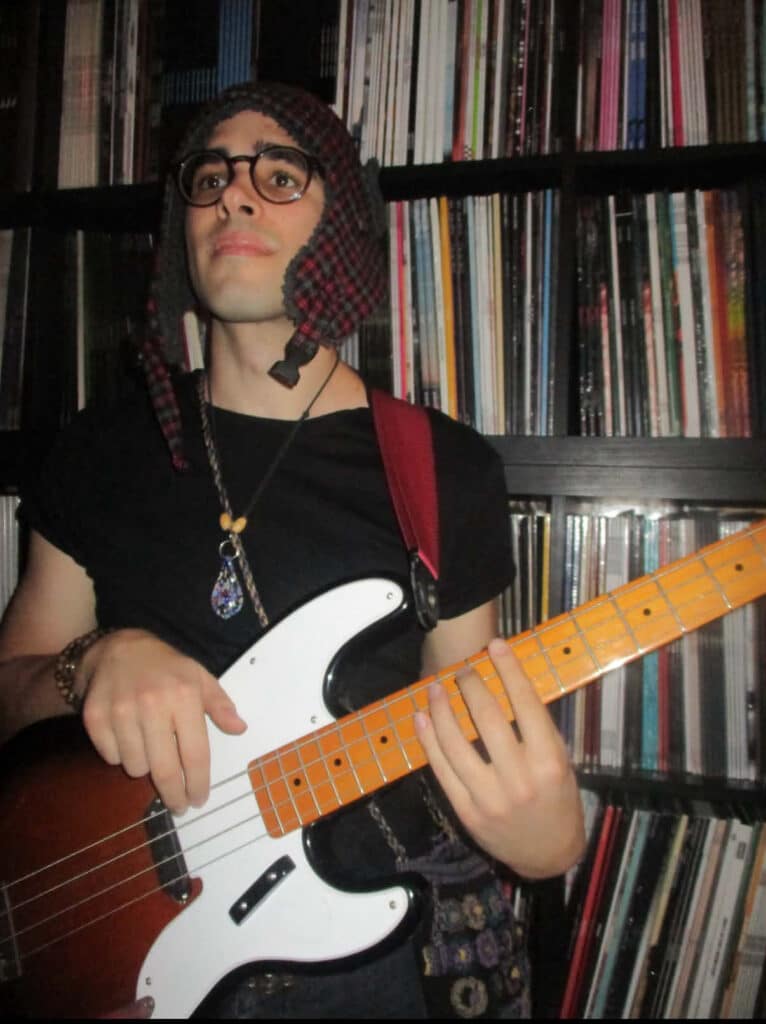
Liam McNeeson is Oddrove. Credit: Oddrove
Interview by Amanda Goceljak
Between recycled trends, manipulative algorithms, and clone-like creators choosing dollars over dignity, it’s become nearly impossible not to drown in stale seas of content. Liam McNeeson, a multi-instrumentalist trudging out of the Southern Florida swamps, offers us a solution: embrace the chaos, and float along.
I spoke with Liam about his deeply personal solo project, Oddrove. His work captures the preeminence of emotion over language and the confusion induced by rigid categories—especially in the music world. Our conversation centers on how the peculiar isolation of pandemic life not only sparked the genesis of his debut album Pop Amoeba but also left a permanent memory of chaos intruding at any given moment.
Amanda: What does your background in music look like? How did your college experience influence your decision to pursue a music career?
Liam: I went to the University of Miami, where I was involved with college radio as a DJ. It definitely formed my interest in music. The program director there, Philip, and I bonded over music and have been all over the local Miami music scene since. So I really hold college radio close to my heart, and I still listen to WVUM all the time. But in my sophomore year of college, COVID hit, and everything shut down.
Before that, I was involved in a few bands that did not work out. Nobody truly knew what they were doing. And that’s the experience! It’s never a perfect start doing things for the first time—especially with other people. As a result, I completely withdrew and do things alone. I only knew power chords and the pentatonic scale in a really messy way.
One of my friends were in a band called Saturday Night Monkeys together—was very good at production. But when we actually got together, recorded, and posted a snippet on SoundCloud, everybody hated it. It’s one thing to produce and write songs on the computer. It’s another thing to play with a band and solidify your sound, and then record. That skill took me around 10 years to fully develop.
What was it like to go to college during COVID?
While we did go back a little faster than up North, it was still around an entire year of Zoom and being away from friends. But the most eerie aspect was going back to school and seeing all of the social distancing signs and stickers, wearing a mask while sitting in a classroom flooded with fluorescent lights. Genuinely, nobody knew how to interact with each other.
I studied Film, and, at one point, I was very serious about it. I was watching a lot of The Criterion Collection and was obsessed with French New Wave cinema—Jean-Luc Godard and stuff like that. Spike Jones from the ‘90s. Soviet filmmakers. Just falling down the rabbit hole. I ended up dropping out of the film program. University of Miami’s film program was cool; there were a lot of inspiring people. But something just didn’t click.
A major theme for you has been the effect of COVID and pandemic isolation on the social and creative conscience. Did pandemic isolation inform your direction on Pop Amoeba?
The album was very much informed by the pandemic. I’m not sure how much of it is apparent. The name itself literally describes an Amoeba that is popping. That Amoeba is not directly about the virus itself, but more so that I used to describe myself as a formless amoeba pre-pandemic, just floating along. And then, suddenly, the entire world popped; a lot of the preconceived notions and general rules or laws of engagement that have informed us in our modern world, that we took to be normal, got completely thrown out the window. Seeing life in a different light makes it hard to go back to normal. Honestly, it still doesn’t feel normal.
When deciding to pursue a solo project, were there any particular artists that you looked up to?
That period when I started to withdraw and do [music] by myself was around the time I started getting into Tame Impala. I was so obsessed with him that I listened to his demos from the late 2000s and downloaded every live jam and performance that he did. There was this section of his Wikipedia page where he talks about his process, where he would record everything—every single part—and layer on top of himself. That’s when I said, “I should just be doing all of this stuff on my own.”
What is the local music scene like in Miami right now? And what’s your personal connection to it?
There’s no one way to describe Miami’s music scene. On the surface, it looks like there’s just a bunch of DJs that form around the city at clubs or at weddings. And a bunch of underground SoundCloud rappers. Lots of Latin music influences, and stuff like that, which are big in Miami. And they form a keystone of what this city has always historically been: think Miami bass and old Cuban revival in the 90s. Drum and bass, Jungle, all of that.
Beneath all of that, there’s an enormous number of musicians—excellent musicians—who perform in smaller venues and form bands with each other. But they’re fractured into so many different small scenes that don’t get to communicate with each other because of the urban planning and history of the city. You can actually see it when you wander around the city.
Back in high school, I would float around many different groups but never be tied down to one single group.
Which is similar to how I feel in the Miami music world. I’ve been in the Kendall and West Kendall indie, pop-punk scene. And then there’s this weird ‘Phil’s House Show,’ that’s just incredibly experimental, showcasing everything from underground rap to math rock. The Frost School of Music kids would do their theatrical, crazy folk-tronic sounds. Then, there are the usual people who play blues and jazz. And, of course, there is a huge hardcore, death metal, black metal scene in Florida. For such a sunny state, we come up with some pretty messed-up stuff.
What happened to this local music scene during and after the shutdown?
Two things happened with the local scene at the time. The first thing was the lack of attendance at venues. Since Florida was one of those states that did not provide much funding or support for the arts and cultural spaces, a bunch of staple venues and social areas closed down. To name a few: Las Rosas, Churchill’s Pub (venue for the International Noise Conference), Ginger’s, Space Mountain. For an entire year, while stuck at home, you were just watching all of these spaces you used to frequent just shut their doors. Churchill’s and Las Rosas only reopened this year. The scene was dying.
The second thing that happened was people trying to host concerts online, which was interesting. One girl started a record label called ‘Safe Space Sessions,’ mostly known for its LGBTQIA-friendly community, while also helping to expose a lot of sexual offenders local to Miami. They hosted an online concert that a hardcore band I was a member of, The Children of Flesh, basically just through Discord with a camera. The sound quality was pretty bad, but we were doing the best with what we had at the time.
When you get that creative spark, where do you go with it? Is it the melody that comes to you first? The lyrics? I know you’re also a visual artist: does a sketch ever inspire a song?
The process usually starts with the music itself. I might start with a guitar, and once I figure out a chord progression, I’ll probably layer some bass on top of it. Then, I’ll do some drums. Sometimes, actually, I’ll just start with a drum beat with no particular chords or melody in mind, and somehow it’s in a verse-chorus-verse-chorus-bridge structure. And then, I would do the reverse: layer the guitar and bass on top of that.
Regardless, it’s always before the voice. And then, when the voice comes, I’m speaking a sort of gibberish. Suddenly, from that gibberish, I can start writing poems that fit the melody, the rhythm, and pronunciation of the gibberish that I was filling in the gaps with. But it’s always the music first. For me, music is where the emotion is.
I was doing some digging around for information on your creative process and found a site called Wavebend Records. You wrote an entire segment about a gnome. What’s that about?
[Laughs] I made up the gnome entirely. I just don’t really know what to say when it comes to descriptions of my music. Even though I wrote the gnome story satirically, the actual thoughts embedded within it are thoughts I’ve been having since 2019. Often, I see content, media, and books circulating in the world that address this, especially with everything going on with artificial intelligence right now.
There’s this one book that I read called The Medium is the Massage by Marshall McLuhan, the guy who coined Media Studies. It’s a very trippy book. It’s got like two pages that are meant to be read in a mirror. That book was the crystallization of all those thoughts I mentioned earlier. It helped me realize where my music fits into all of this, because it is all about the feeling. Yet, I wasn’t thinking about that when I was doing it. I was just doing it and feeling it.
How do you feel about genre labels? Do you find that they take away from the emotion?
I would say yes. The other day, I was in a coffee shop working on a few dozen drawings, alongside handwritten letters to send to people I’ve worked with. This lady comes in, filming a promo for the coffee shop. She looks down at [my drawings] and asks me what I’m doing, and I tell her, “Oh, it’s for my album,” and she asks me what genre of music it is.
I’m like, “I don’t know.” I’ve said alternative, I’ve said psychedelic, I’ve said Shoegaze, but they all feel wrong. And, now, I say it’s just music.
How many bands are you in right now? Any other creative projects other than music?
Three. Right now, I’m in a band called It’s Star with Issaih, Fae, Julian, and Seth. That’s the band that I have the mixing session with today. I’m in another band, (tentatively) Cash In, with these guys named Psy and Richard. Oddrove is obviously my project. That’s my baby.
Music is definitely my main focus right now, but I’ve dabbled in a lot of different creative forms. I have a lot of poetry that I’ve written that I’d like to publish in collections, one day. I fill up sketchbooks with drawings—actually, a lot of artwork for [Pop Amoeba] was taken from my sketchbook.
Thanks so much for taking the time to talk about Oddrove today. I know you’ve got to head to a mixing session soon—so, any final takeaways or lessons?
Music is meant to be felt. The biggest thing that I could ask for is that people feel the music. That’s the most important thing to me. ‘Cause that’s what I like about music. That I can feel it, and that I feel connected to the artist or something higher.
This interview has been condensed and edited from a longer conversation.
Oddrove’s debut album is available here. You can also follow him for more updates and check out his sketches on Blank Outlines.