
RUSA Report February 19: Chancellor Conway speaks, legislation passed
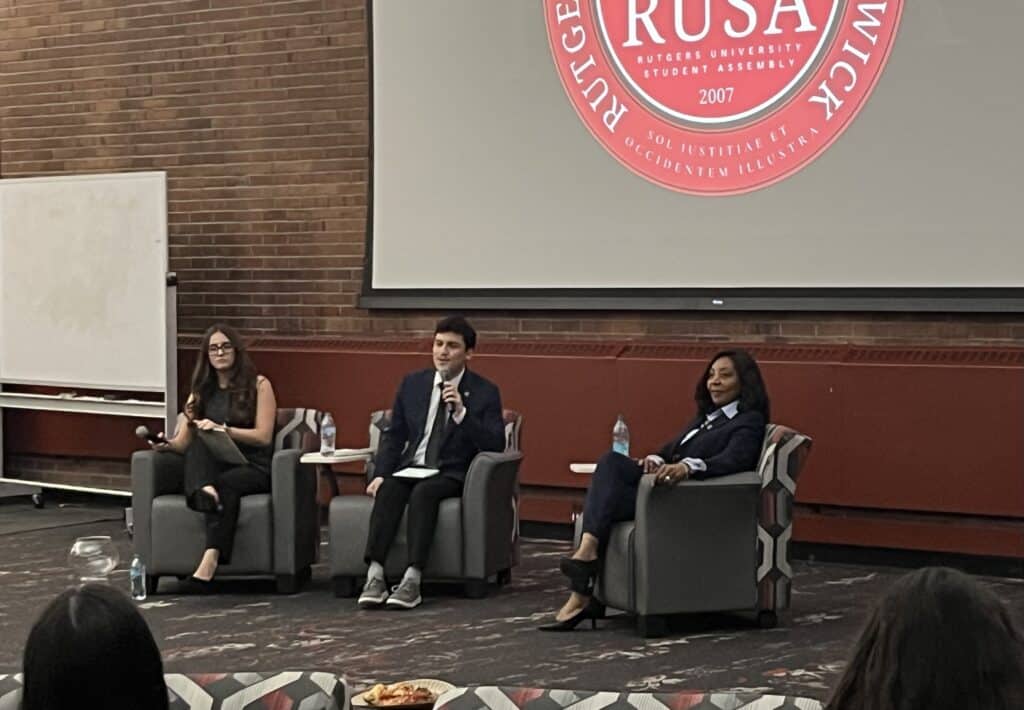
Photo: Andrew Hawthorne
University Chancellor Francine Conway sat down with RUSA leaders at a meeting Thursday to answer questions from the assembly on issues regarding student life and the future of the University.
The assembly also passed legislation to support student interests in state and federal legislation, as well as heard proposed changes to RUSA’s standing rules to improve efficiency and close loopholes.
Sit-down with Chancellor Conway
Conway and other administration leaders discussed difficulties with increasingly large incoming classes, upcoming improvements to campus infrastructure, and uncertainties created by federal grant cuts and immigration crackdowns.
Conway acknowledged the concerns students may feel about federal immigration enforcement operations coming to campus. She also said she and her team are working to prevent Immigration and Customs Enforcement officers from coming onto campus, and reassured students that Rutgers has prevented any deportations from happening on campus.
“We are being vigilant and being communicative with those students who might be impacted,” Conway said. “So, if you know of anyone or you’re in a situation, reach out to us. You’re not alone. We’re here to help.”
Conway continued that University administration is working with the New Brunswick government and local police forces to determine the best course of action when dealing with immigration enforcement and develop community-based solutions to help all New Brunswick residents.
Discussing other federal actions impacting the University, Conway discussed how her office responded to the sweeping grant cuts by the Trump administration. She noted the use of emergency funds to help students who rely on federal grants that have been cut, as well as providing legal consultation for foreign students who worried they may not be able to re-enter the country if they visited home.
When answering an assembly member’s question on advancing infrastructure projects, Conway said the volatility of the federal government has restricted University administration’s ability to continue some projects.
“The world has shifted in terms of just how federal policies are impacting what universities can do,” Conway said. “We are being scrutinized, so finding ways to both comply with the law and our mission has become a little bit more challenging.”
Conway discussed several infrastructure improvements still underway on campus, including optimizing campus buses, improving commuter spaces, and revitalizing the Douglass campus.
Conway noted that the fate of the currently closed Brower Commons on College Ave is still undetermined, as it may be renovated or demolished depending on the safety of the building.
Conway also discussed her team’s efforts to make a Rutgers education accessible to as diverse a population as possible. She continued that administration is currently trying to help more students learn about services already available to them, including scholarships, affordable study abroad opportunities, and Discovery Advantage, an initiative to enhance student experience.
Senior Vice Provost and Vice Chancellor for Undergraduate Education Carolyn Moehling also addressed the assembly to announce that Discovery Advantage is currently looking for input from RUSA members as they look for replacements for Degree Navigator, the primary tool for tracking requirements for students. Moehling noted that replacing Degree Navigator has been a popular issue among students and assembly members.
Conway also noted challenges regarding the increasingly large incoming classes each year, which she attributed in part to Rutgers being added to Common App admissions application, making it easier for prospective students to apply. According to Conway the larger application pool has led to lower admission rates and raised concerns about the number of students per course section increasing.
Conway continued that administration is working to keep a Rutgers education accessible to all kinds of students. She also committed administration to increasing the number of course sections overall rather than increasing section sizes to ensure classes stay manageable for faculty and personal for students.
Legislation passed and presented
The assembly passed the Student Advocacy and Student Voice Act of 2026, which declared RUSA supports several pieces of pending state legislation that affect student interests.
Many supported bills target issues that affect public institutions for higher education statewide, including creating caps on annual tuition hikes, requiring all students to take a course on climate change, and for protections of free speech.
Other bills target issues specific to Rutgers, including allocating funds to certain Rutgers programs and adding two student representatives to the Board of Governors.
The RUSA bill also resolves that the assembly opposes a bill that would make some students, including undocumented students, ineligible for state financial aid.
The bill additionally allocates $1,000 from the RUSA Presidential Budget to fund an event to promote the “Student Lobbying Toolkit” created by the Legislative Affairs Committee to help students advocate for student needs on the state and federal levels.
In a separate bill, the assembly passed a resolution to support efforts to make textbooks more affordable for students.
The resolution urges Congress to renew the Department of Education’s Open Textbook Pilot, which funds open textbook programs at higher education institutions across the country. Open textbook programs create or expand the use of openly licensed, digital textbooks to make course materials more affordable.
The resolution also asks the University to incentivize the use of open textbooks and end the practice of automatic textbook billing, which are automatically added to student term bills unless rejected by the student. The resolution instead calls for opt-in programs so students may have greater control over their term costs.
The bill also commends higher education advocacy group NJPIRG and Rutgers Library for their work promoting affordable textbooks. This comes as NJPIRG renewed their advocacy for affordable textbooks with a new report and a press conference on campus earlier this month.
The assembly also passed changes to the RUSA standing rules as presented at a meeting last week. The bill primarily targets caps on office hours for assembly members and leaders that were largely unenforced.
All three enacted bills were passed with unanimous consent.
RUSA leaders also presented additional changes to the standing rules for a bill to be voted on at a meeting next week.
The bill aims to repeal unenforced rules and mandates, including a requirement for weekly caucus meetings and a mandate to record the voting history of each individual assembly member.
The bill also improves the language in the assembly’s election procedures and renamed the Sexual Violence Education committee to the “Advocacy, Prevention and Assistance Committee” to reflect a wider range of issues overseen by the committee.
RUSA President Christopher Godoy also presented an executive order he signed appointing the Spring 2026 Elections Board to oversee the upcoming committee chair elections and Spring 2026 Referendum Board to oversee RUSA’s semesterly referendum, which allows students to vote on student government issues.
The Election Board will be led by Academic Affairs Chair Alyssa Lindsay, and the Referendum Board will be led by Parliamentarian Vinya Lingamneni.
The full meeting minutes for the February 19 meeting can be found here.