
RUSA Report February 27: Referendum to change constitution proposed
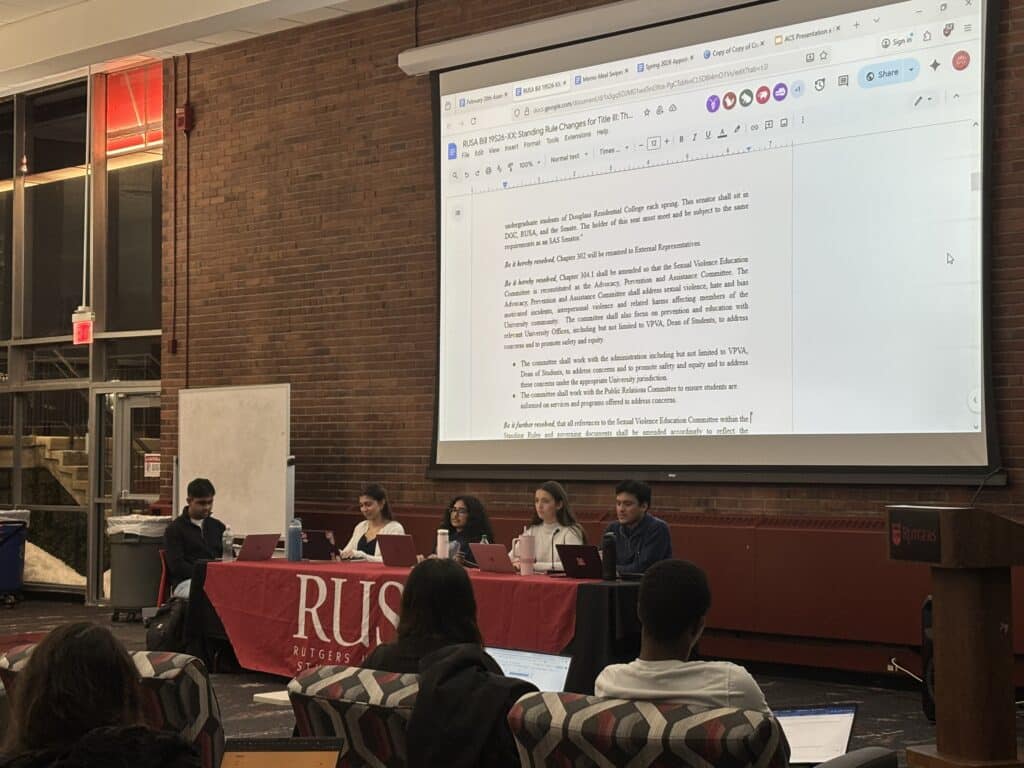
Photo: Noah Choi
The student assembly heard legislation to hold a referendum to make changes to the RUSA constitution and passed changes to their standing rules in a meeting Thursday.
The assembly also heard from student leaders of the Rutgers chapter of the American Cancer Society. RUSA will be working with the student charity group this semester as part of the Meal Swipe for charity initiative.
The referendum would allow students to vote on a bill to update the constitution in an effort to improve its language and the efficiency of the assembly. According to the RUSA standing rules, any changes to the constitution requires a referendum where all students may vote.
If passed, the bill would have the referendum propose the following changes:
Changes to assembly and council positions
The ratio of residential representatives, such as Busch Representatives or Cook Representatives, to students living on that campus would reduce from one representative per 1,000 students to one representative per 1,500 students. With an increasing student body, this is an attempt to keep the assembly size from becoming unmanageable.
The positions of School of Nursing Representative and School of Management Relations Representative would be created. Following the change, there would be one student appointed to each position. Currently, the positions do not exist because there are fewer than 1,000 students in those constituencies, but another part of the constitution calls for representatives for all University schools with any enrollment.
A term limit of 2 years would be added to Judicial Council members. The position of Parliamentarian would be added as a non-voting member to the Judicial Council.
Changes to position eligibility
Members running for elected positions must agree to a code of conduct and a check of their academic history. The election committee would be given access to member records such as instances of academic dishonesty and reports of physical violence to assure candidates abide by that code of conduct.
The requirements to run for elected positions would also have to be a student at Rutgers-New Brunswick, excluding Newark and Camden students. Candidates would also not be able to run if they would graduate before their term in the position ends. Presenters said these requirements are already implied and practiced, and this change would codify it.
Rules of eligibility for candidates for RUSA President would also change. The requirement for candidates to have one year of experience in RUSA would be removed. Instead, candidates must have attended 60% of the meetings in the assembly year in which they run. Presenters said this is to reduce vagueness in the one year experience requirement. The attendance percentage requirement was increased from 50% to 60% with an amendment passed during the meeting.
A rule which only allows SAS students to apply for class representative positions, such as Class of 2027 Representative, would be removed. Presenters said this change would allow a greater diversity of students to apply for these positions.
Other changes
A rule limiting student organizations from both the RUSA allocations board and University professional schools would be removed. Currently, student organizations may only receive funds from the allocations board or professional schools. With the change, student organizations would be able to receive funds from both sources simultaneously.
A mandate for all voting members to attend a weekly caucus meeting would be removed. The mandated caucus meetings are currently not held or enforced. Presenters said three required meetings each week is an excessive time requirement for voting members. This would also close a loophole which would allow a voting member’s position to be challenged for not attending meetings that are not held.
The Anti-Discrimination Statement would be updated to include a statement stating the University’s requirement to avoid discrimination under U.S. law.
Several less impactful changes to the language of the constitution would be updated, such as removing unnecessary words, using more precise language, and updating outdated terms for University establishments.
Other aspects of the bill
In addition to the changes to the RUSA constitution, the bill would allocate $1,500 to the Public Relations Committee to advertise the referendum. The committee would run a social media campaign and table across campus to inform students of the referendum and how it will affect RUSA.
The bill also outlines how the ballot would present the changes to students during the voting period. There would be three locations on each campus where students may cast their vote.
For the referendum to pass, 10% of the student body must vote in the referendum, and 50% of votes must be in favor of the changes.
The assembly will vote on the bill to hold the referendum on Thursday, March 5. If passed, the referendum will have a voting period open to all students from March 8 to March 12.
The assembly also passed a bill presented last week to update the RUSA standing rules.
The bill primarily seeks to remove unenforced requirements, including another mandate for attendance at the unenforced caucus meetings and for the tracking of each voting member’s individual voting history. Multiple amendments were passed altering the bill as it was presented last week.
One amendment was added to the bill, creating a provision that a member’s voting history can be compiled by the Secretary or Parliamentarian upon request, with exceptions for votes with no written documentation, such as spoken votes and votes by raise-of-hand, and votes explicitly intended to be kept anonymous.
Another added amendment targeted a section of the bill regarding what organizations may sponsor a RUSA bill. According to the standing rules, all RUSA legislation must be sponsored by a RUSA committee leader or by a Rutgers organization.
The added amendment widens the scope of organizations who may sponsor a bill from organizations funded by RUSA to any student organization recognized by Rutgers University. The amendment also says legislation sponsored by RUSA funded organizations will be given priority by the assembly.
A third amendment targeted a section changing the name of the Sexual Violence Education committee to make the new name more clearly. The committee will now be called the Prevention, Assistance, and Advocacy Committee.
The bill passed with all amendments accepted. The vote saw 32 in favor, two against, and three abstaining.
The bill and the referendum are the product of a constitutional ad-hoc committee to improve the assembly’s efficiency and make the founding documents match the assembly’s practices. The committee also created two other bills to change standing rules that were passed at meetings earlier this month.
Student speakers from the American Cancer Society discussed their organization’s mission to support people with cancer and alleviate financial burdens that come with cancer treatments.
Speakers also discussed their advocacy work, including tabling, fund raising, and “Relay for Life” events to raise money and awareness. Speakers said they raised $17,500 last year and hope to raise more this year.
Following the presentation, RUSA president Christopher Godoy presented a memo naming the Cancer Society for America as the charity of choice for the Meal Swipes for Charity program. At the end of each semester, the program allows students to donate some number of their unused meal swipes to be converted into a dollar amount and donated to the charity RUSA selects.
During officer updates, SAS Senate Leader Tony Pichardo noted several charges being heard by the SAS Senate.
One charge includes a recommendation for University Administration to implement methods to reduce instances of “deadnaming” or using names other than the one preferred by a student.
Another charge asks the University administration to work with NJ transit on a student discount on roundtrip train tickets, specifically to help students with internships and other academic opportunities who rely on public transport.
DEI Director Alejandra Alfanador noted another senate charge furthering the efforts of a RUSA bill passed earlier this month to provide protections for free speech and undocumented students.
Vice President Lily Sousa announced eight new appointments to RUSA committees. The appointees will become voting members once sworn in at a meeting next week.
At the start of the meeting, Godoy held a moment of silence for student Amber Torres, who recently passed away.
The full meeting minutes for the February 26 meeting can be found here.
Story by Andrew Hawthorne and Noah Choi