
RUSA Report March 5: Assembly to hold referendum, Concerns raised for amendment to elections bill
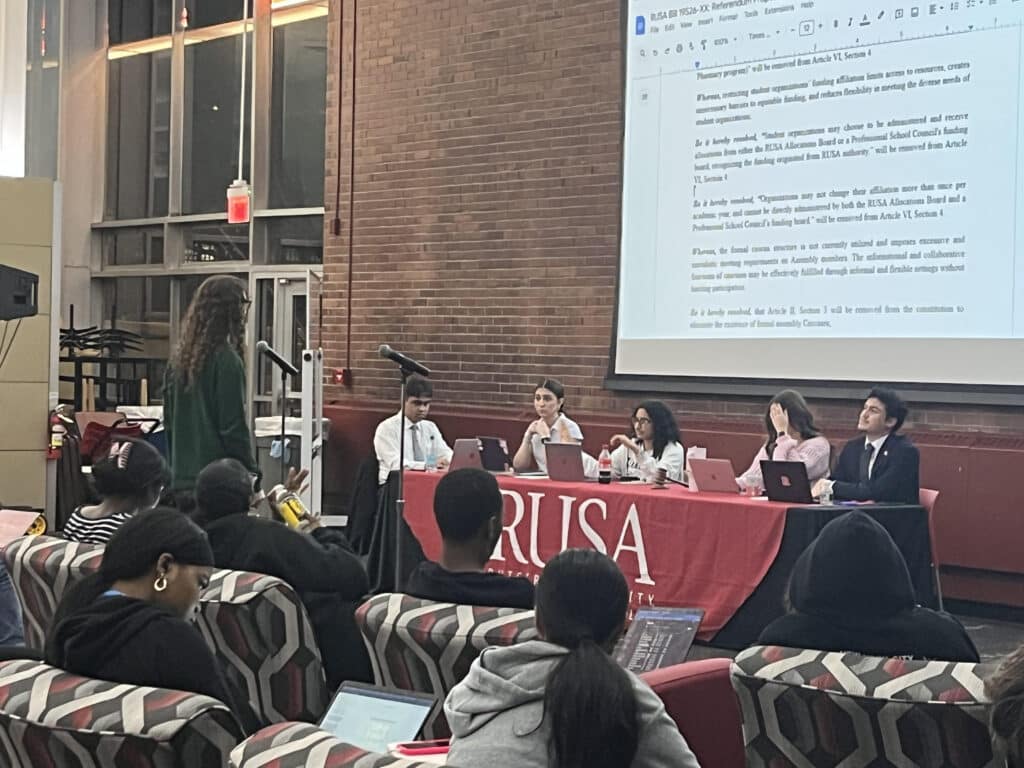
Photo: Andrew Hawthorne
RUSA will hold a referendum from March 8 to 12 on changes to the assembly’s constitution, after a bill to do so passed at a meeting Thursday.
The assembly also heard a bill to change the assembly’s standing rules on elections and added an amendment that Parliamentarian Vinya Lingamneni said could lead to the overturning of future elections.
RUSA also passed a bill officializing a RUSA statement on discrimination. A controversial bill on student organization funding guidelines was planned to be presented at the meeting, but was tabled for a meeting next week.
Bill to hold referendum passed
If the referendum passes, the constitution would be updated to remove unenforced rules, make existing rules less vague, and reduce the ratio of residential representatives to campus students to match the University’s increasing class sizes. The bill to hold the referendum was originally presented at a meeting last week.
During the five day voting period, all students will be able to vote at one of two tables on each campus. Students will also be able to see the changes to the constitution and get information on what the referendum would mean for RUSA’s operations.
For the referendum to pass, at least 10% of the student body must vote in the referendum, with over 50% of votes in favor of the changes.
The bill to hold the referendum was passed with few significant changes from how the bill was presented last.
Many meeting attendees questioned a portion of the constitution changes that would remove an unenforced rule prohibiting student organizations from receiving funding from a University professional school and from RUSA at the same time. Some attendees said that the change would limit student organization funding.
Lingamneni, presenter of the bill, and other RUSA leaders repeatedly told attendees that they may be confusing the clause with a standing rules bill pushed to next week. Lingamneni continued that the changes to the constitution would have little to no effect on student organizations or their funding.
An amendment to remove the clause was put to a vote, but failed by a wide margin.
The bill was passed with a two-thirds supermajority, as is required to hold any referendum.
Bill to change election procedure, Parliamentarian’s warning on amendment
The assembly also heard a bill to change the RUSA standing rules around election eligibility and process. Many of the clauses of the bill are dependent on the referendum passing, as the referendum will restructure some of the election process.
If passed, members of the election commission, the group responsible for running the election fairly, would be required to sign a non-disclosure agreement to ensure the inner workings of the election process are kept confidential from candidates and voters.
The bill also attempts to standardize the time windows allowed for voting and for candidates to declare their candidacy. If passed, candidates must submit their intent to run at least 10 days before the election, changing standing rules that set different windows for elections in the fall and spring semesters.
The bill would also allow the elections committee to decide voting periods with consideration for “community and religious holidays” that might fall during a voting period and make it harder for some students to vote. The bill originally only required consideration for “community holidays,” which would include religious holidays. An amendment to add specific mention of religious holidays was requested by Kelly Shapiro and was passed by an assembly vote.
Shapiro said she wants to ensure there is no room for interpretation in the recognition of religious holidays, citing previous elections that fell on Passover, which reduced the opportunity for some Jewish students to vote due to religious restrictions.
Shapiro also proposed an amendment to change the voting period from five days to “at minimum five days,” with power given to the election committee to extent the duration if needed to maximize the amount of students who can vote. Shapiro cited similar reasons of certain cases where Jewish holidays would make it harder for some students to vote.
Lingamneni, who also authored the election standing rules bill, warned the assembly that if the election committee were to ever use that power, any assembly member would be able to appeal an election to the for having a different voting period than other years. Linganeni continued that the appeal would most likely be approved by the Judicial Council and the election would be overturned.
Despite Lingamneni’s warning, the amendment was passed in an assembly vote.
The election standing rules bill will be voted on at a meeting next week.
Assembly passes anti-discrimination statement
The assembly also passed a bill to adopt an official “Assembly Statement on Racism, Bias and Discrimination.”
The statement condemns hate speech, reaffirms RUSA’s commitment to supporting academic free speech, and prohibits discrimination based on protected classes including race, gender, sexual orientation, and national origin
The bill cites multiple other anti-discrimination statements by other University groups and calls for RUSA to adopt one of their own, which will be added to the RUSA website homepage.
The bill was passed with unanimous consent.
Student organization funding bill moved to next week
A controversial bill to change the assembly’s standing rules regarding the guidelines for student organization funding.
The bill primarily seeks to eliminate unenforced rules, make the guidelines match current practices, and codify existing guidelines. The bill also codifies organization audit procedures, changes some responsibilities for organization presidents and treasurers, puts a $200 cap on funding allocated to newly registered organizations.
The bill is expected to see some pushback from the student governing councils of academic schools, as the funding guidelines would apply to all student organizations. This would overturn a long-held rule that the governing council-funded organizations are regulated separately from RUSA’s guidelines.
Funds allocated by the governing council come from the RUSA-controlled student fee and are within the assembly’s jurisdiction under the RUSA constitution.
With the bill’s postponement, the governing councils will have more time to go through the bill and voice any concerns. Governing council members can not on RUSA bills legislation.
The bill will be presented at a meeting on Thursday, March 12, and is expected to be voted on at a meeting on Thursday, March 26.
Other meeting events
Internal Affairs Chair Adam Halperin reminded the assembly that all representatives to academic bodies, such as School of Business Representative or School of Pharmacy Representative, must be re-elected to keep their positions next year. He urged all candidates to declare their candidacy soon.
During time for public comment, Deputy Chief of Staff to the Vice President Devon Davis raised concerns regarding street lights on the Busch campus that have stopped working. Davis said the out lights have almost caused multiple accidents and are a risk to public safety.
The full meeting minutes for the March 5 meeting can be found here.