
Rutgers community and New Brunswick join national ‘No Kings’ protest
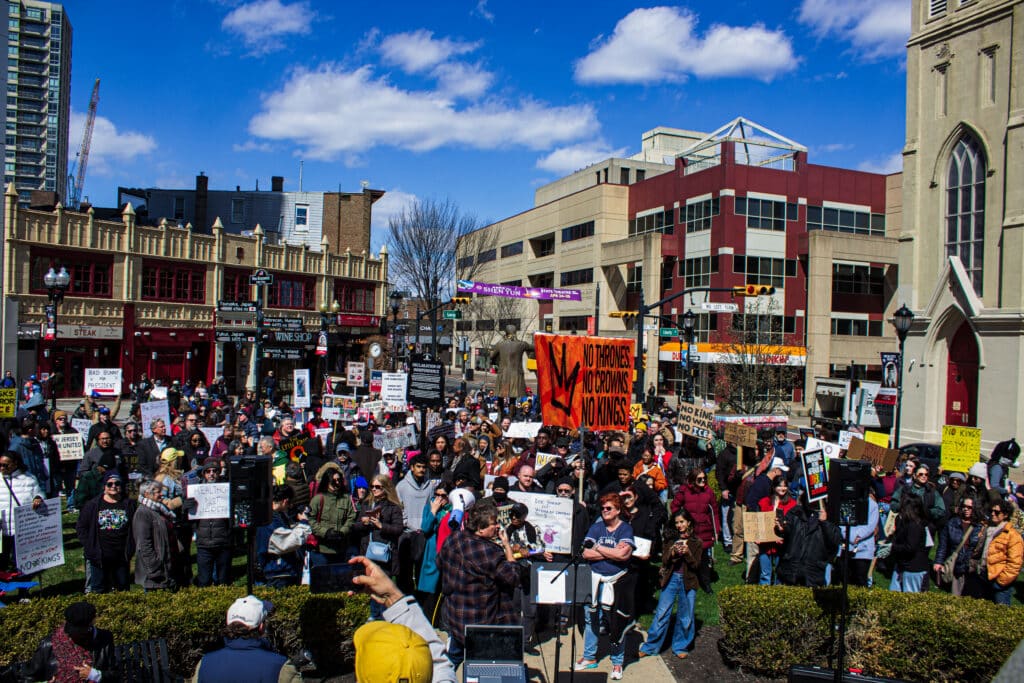
Demonstrators gather for the "No Kings" rally in New Brunswick (Photo: Brea Yumiguano)
Students and community members gathered to hear speakers, music, and demonstrate against the Trump Administration on College Ave and in downtown New Brunswick last Saturday.
The event was part of the No Kings protests across the country. Demonstrators began outside the Brower building and marched to Civil War Memorial Park, passing in front of administration buildings on Old Queen’s College.
The event was organized by multiple University and community groups as part of the No Kings coalition, including immigrant advocacy group DIRE, the Rutgers chapter of the Young Democratic Socialists of America, Undocu Rutgers, March Forward Franklin Township, and the Rutgers University Adjunct Faculty Union.
Michael Steinbruck, a lead organizer for the event, said the demonstration was a success and was grateful for the opportunity to participate in such an important cause. “The coalition is a work in progress, but the event speaks for itself in terms of the diversity and the appreciation everyone has for each other,” Steinbruck told WRSU. “I’m blessed just to kind of play a role greasing the wheels that got everyone together.”
Speakers included students, organization leaders, and faculty members. The event also saw a musical performance by local singer Silent Knight. Sanchi Sharma, a student, introduced speakers on College Ave and in New Brunswick.
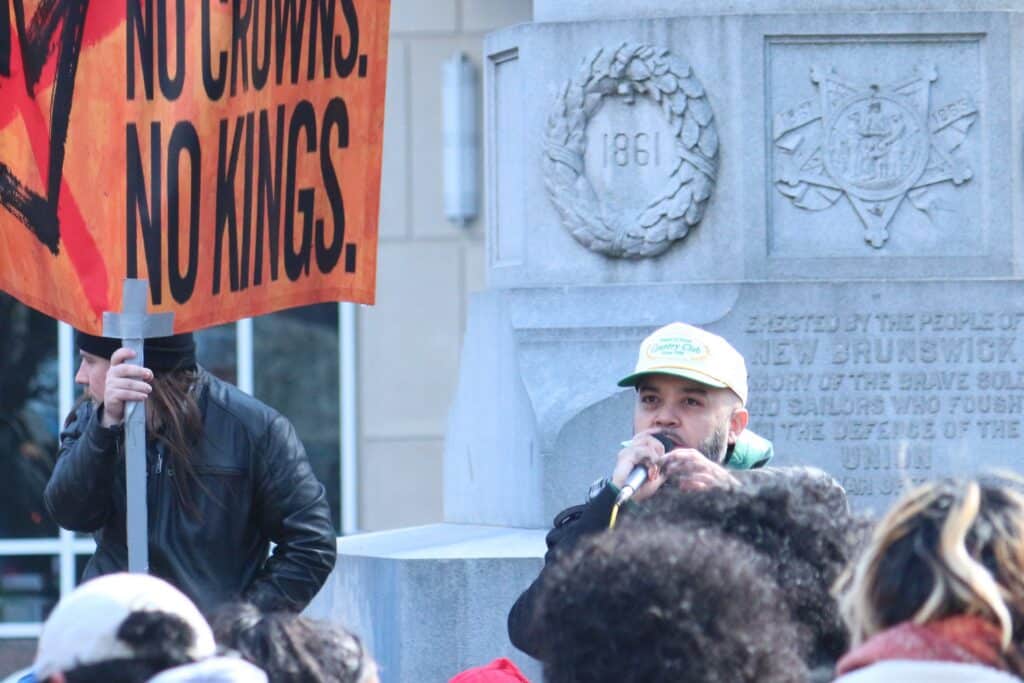
Demonstrators chanted against the nationwide immigration crackdowns, military involvement in Iran, and the Trump administration’s policies, which many called fascist. One student speaker, Isaiah, discussed the importance of demonstrating in ways that inhibit the Trump administration’s immigration crackdowns, telling attendees to “get in the way”.
“If they’re trying to open a new detention center, if they’re trying to arrest our neighbors, if they’re trying to kill our families, we need to get in the way,” Isaiah said to demonstrators. “When they try to silence our voices, we need to show them that we can not be silenced.”
Representative of DIRE Ellen Whitt described stories of recent ICE detainments in New Brunswick she heard while operating the DIRE Hotline, where people can call in with immigration related emergencies.
Whitt described a group of workers detained without having their citizenship checked, and a father who had his car windows smashed by ICE while he dropped his daughter off at school. “That is, in fact, who they’re criminalizing: workers, parents, people of color,” Whitt told demonstrators. “They label them as criminals to divide us with the hope that we won’t see, we won’t say anything, we won’t speak up.”
Multiple speakers and chant leaders called on the University to declare Rutgers a sanctuary campus, where immigration enforcement officers have limited access to entering campus.
A co-president for Rutgers YDSA said her group is calling on the University to take a more active role in resisting the Trump administration. Rutgers YDSA is currently promoting two petitions asking the University to take more proactive steps to resist the Trump administration.
“We’re fighting for Rutgers to be a sanctuary campus, so that everyone on campus is safe,” the YDSA leader told WRSU. “We also want Rutgers to drop its contracts with ICE’s corporate collaborators: Enterprise Car Rentals, Hilton Hotels, and GlobalX Airlines. Those are the companies that enable ICE to keep doing what they’re doing, and we don’t want to be part of it.”
Speakers also discussed their frustrations with University administration for closing their office of University Equity and Inclusion and removing DEI programs and DEI language from University materials in compliance with an executive order from the Trump administration.
Student Jakob Pender, a representative of the Rutgers Queer Caucus, spoke to attendees about his frustration on the removal of DEI language and his concerns on how the university may continue to roll over to federal demands in the future. Speaking with WRSU, Pender said students should voice their concerns about these issues, but administration makes it difficult to do so when students are left out of discussions that directly affect them.
“Students didn’t know [about the DEI program removal], a lot of faculty didn’t know, a lot of even departments that are supposed to be protecting this didn’t know,” Pender said. “We need to make sure we are being together and taking the right actions and communicating with each other.”
Some politicians made appearances, including Representative Frank Pallone for New Jersey’s sixth congressional district.
Pallone discussed his frustrations with the Trump administration’s overreach and contempt of checks and balances. “Every day you see Trump saying…he literally says he wants to put aside the constitution. He doesn’t pay any attention to Congress,” Pallone told WRSU. “But I think for a lot of people, it’s just a constant fight to protect Democracy. That’s at stake, and that’s why we’re here.”
High school student and candidate for student representative of the New Brunswick Board of Education Oscar Garcia spoke about the need for young people to notice problems in their community and speak out to fix them. Garcia said he intends to pursue a career in politics to help young people when their voices often go unheard.
“I want to speak for those young people who are afraid to use their voice,” Garcia told WRSU. Discussing the recent protest by students at Piscataway High School, he continued “There are some students that want to speak up, but they’re kind of afraid to.”
WRSU also spoke to two Piscataway High School students, who were inspired to join No Kings after a protest at their school garnered a lot of support. One student discussed her experience seeing the immigration crackdowns as an immigrant herself. “If we don’t show up, no one else is going to,” the student said.
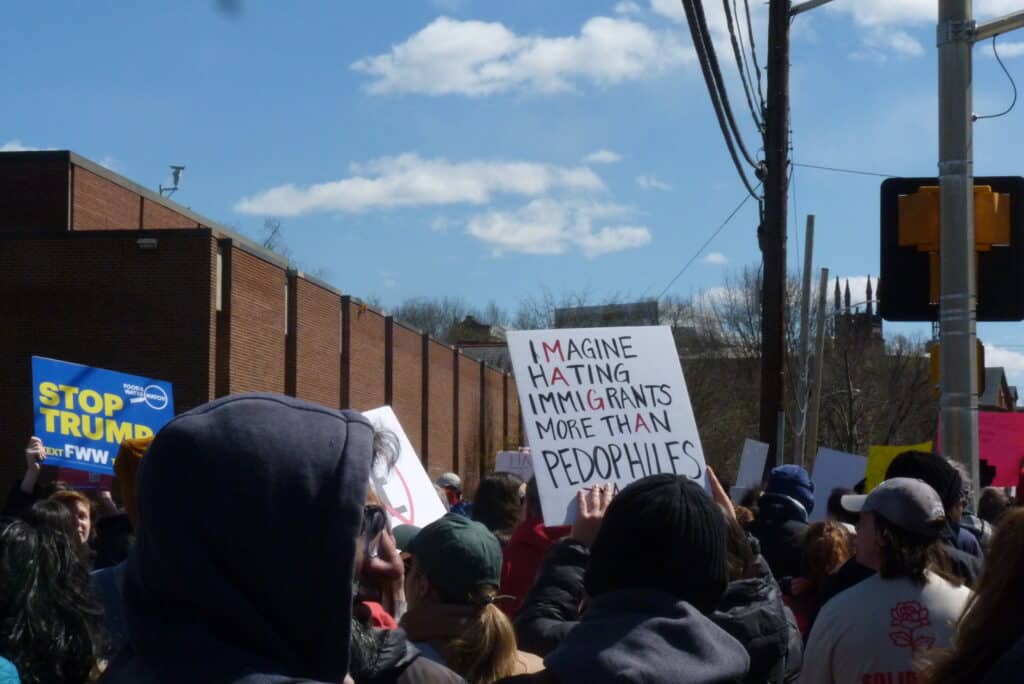
In addition to students, much of the crowd were older members of the community, many of whom have been politically organizing for decades.
One couple said they marched for civil rights and women’s rights in the ‘60s. They said they were inspired to see young people continue to politically mobilize, and stressed the importance of continuing to resist repressive policies. “[In the ‘60s] we fought for the rights that we have today,” the demonstrator said. “It’s time to do it again.”
One demonstrator, Bryan Douglas, said he was a part of political demonstrations at Rutgers in the ‘90s. He also said he was the adoptive grandson of Vietnam War-era activist and pacifist David Dellinger, who Douglas said inspired him to become an anti-war activist.
“I was part of a coalition in ‘91 at Rutgers for the first Gulf War. We met at the statue every Friday night while the first gulf war was going on,” Douglas said. “Dave Dellinger went to Vietnam and he saw schools blown up, hospitals – the same thing that’s going on right now in Iran.”
Another demonstrator, Andrew Bencivenga, also known as Ben Sheisty, said he became involved when immigration enforcement targeted his community in Edison, and his local government failed to act. “ICE has [been] targeting my community in Edison…I even alerted my mayor about it, and they told me there was nothing they could do,” Bencivenga said. “People are trying to make a living and the last thing they need is ICE separating families, and it’s disgusting.”
During the speeches on College Ave at the start of the protset, some trucks and cars decorated with Trump-supporting flags circled College Ave as a form of counter protest, including a flag justifying the deaths of Alex Pretti and Renée Good at the hands of federal agents. Other flags included the Gadsden flag, the Israeli flag, and various American flags.
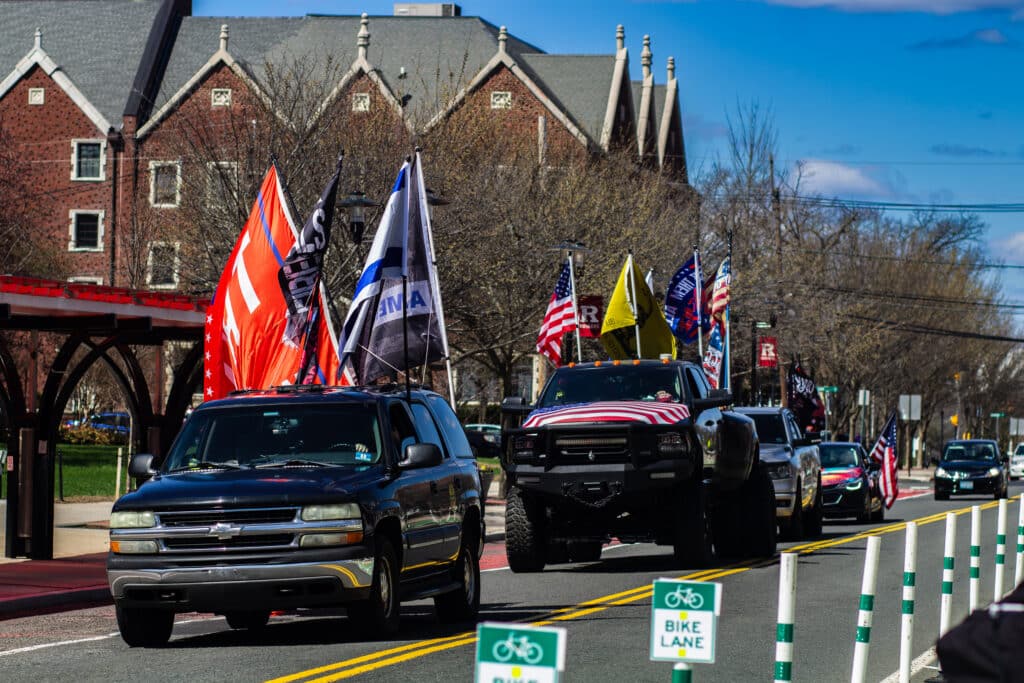
Organizers warned attendees not to escalate things with counter-protestors and cause unnecessary conflict. The counter-protestors dissipated before the group reached Monument Park. The demonstration was part of the No Kings movement, which has grown in response to actions by the Trump administration during his second term in office. The protest was the third major No Kings Day protest, and the first No Kings demonstration in New Brunswick.
The New York Times reported nearly eight million people attended No Kings demonstrations on Saturday with l over three thousand events across the country.
Steinbruck said the No Kings coalition plans to continue demonstrating in New Brunswick with future demonstrations in the coming months.
Story by: Andrew Hawthorne, Nina Davis, Noah Choi, Rahil Chatterjee and Avani Trivedi