WRSU Exclusive: Interview with RUSA President Christopher Godoy
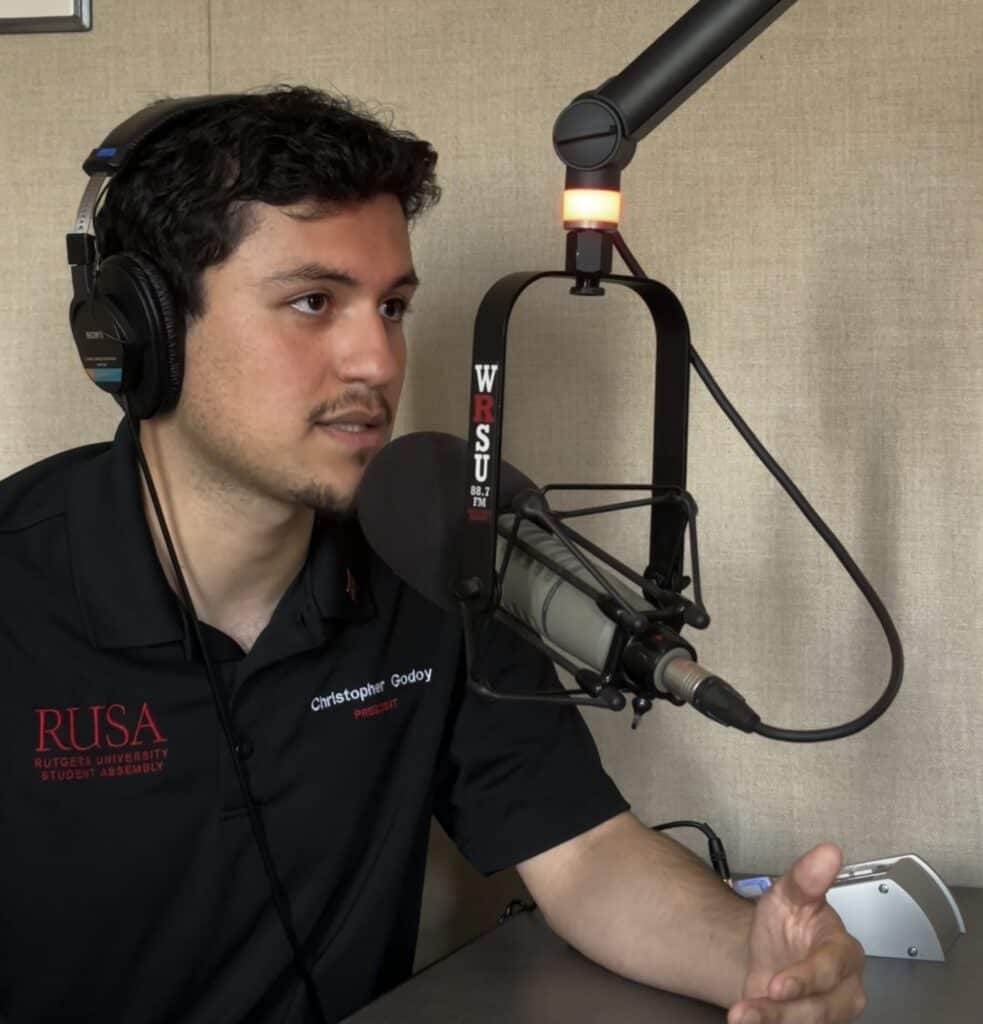
Photo: Noah Choi
WRSU sat down for an interview with Rutgers University Student Assembly President Christopher Godoy to discuss the notable RUSA legislation and initiatives from the past year, as well as Godoy’s insights to student government from his career in RUSA.
Godoy discussed the resolution passed by the student assembly asking administration to restrict immigration enforcement’s access to areas on campus as nationwide immigration crackdowns reach New Brunswick, as well as his insights for RUSA’s future.
Godoy also discussed the bill to change to student organization funding guidelines, which failed to pass at a meeting last month, but was revived and passed at the last legislative session of the semester on April 2. The interview took place before the bill’s revival, but Godoy’s reactions immediately after the bill was passed can be found among the questions below.
Can you briefly describe the other positions you’ve had during your career in RUSA?
Can you describe some the relationships you’ve formed with administration leaders and other student leaders?
What is an initiative you laid the groundwork for that you hope the next administration will bring to fruition?
What are some lessons have you learned as president that you hope the next administration can learn from?
During your term, you worked on a few initiatives to promote political advocacy on the local, state, and federal levels, including advocating for pushing for affordable textbook policies with NJPirg, promoting the UWill program to the governor’s office, and advocating for the State Advocacy and Student Voice Act, a resolution to support many bills on the state and federal levels. Can you speak on why this was a priority, and how the next administration can continue this push for more political engagement?
We also wanted to talk to you about the Sanctuary campus bill with Undocu Rutgers and University Administration. This was a controversial and landmark bill that furthered many still-ongoing pushes for the declaration of ‘safe zones’ on campus, where immigration enforcement would need a warrant to enter. Where does the bill stand, both in terms of administration’s response and RUSA’s promise to create a protocol on how to respond to ICE coming to campus?
Recently, you authored and helped present a bill that would change the guidelines for student organization funding. Most notably, it would have made all student organizations subject to the RUSA guidelines, including student organizations funded by the governing councils of governing schools, which have historically operated under separate guidelines. This bill saw significant pushback from those governing councils and ultimately failed when it reached the assembly floor. What was your motivation behind the bill, and what are your reactions to its failure to pass?
Note: At the time of the interview’s recording, the bill to change the student organization funding failed to pass on the assembly floor. The bill had not yet been revived and passed, so Godoy’s response regards his reaction to the bill failing.
What can the next administration learn from the process of the funding guidelines bill? Do you want them to continue to push for a change like that and what do you think the ideal relationship between RUSA and the governing councils looks like?
WRSU asked Godoy the following questions at the RUSA meeting on April 2, immediately after the bill was revived and passed. These questions were asked after the interview above.
The funding guidelines bill just passed. What are your reactions to that? What do you think changed from the vote last week?
RUSA held a referendum last month, which would have amended parts of the RUSA constitution. The bill mostly updated the constitution to match current practices, but also would have added two new representative seats to the assembly and decreased the ratio of representatives to students to match the increasing class sizes. As the student body learned at the last meeting, the referendum failed to pass due to a lack of votes from the student body. From our understanding, this is not the first time the assembly has struggled to get student involvement in RUSA referendums. What was learned from this referendum, and how do you think RUSA can boost student involvement to let the election be about the legislation itself?
With those two pieces of legislation – the referendum and the funding guidelines bill – some speakers at RUSA meetings saw some confusion about the contents of the legislation. They also led to some movements against the legislation online and on campus, with students believing either bill would restrict the amount of funding a student organization receives, even though neither bill impacted the budgets of student organizations in any direct way. Do you think misinformation and confusion like this played a part in the result of that legislation? Does it demonstrate a problem RUSA could address in the next assembly, and how?
Last semester, the government shutdown and loss of SNAP benefits created a greater reliance on the Basic Needs Center on campus, which provides students with food and other basic necessities. The Basic Needs Center came to discuss these issues at RUSA. You personally signed an executive order giving one thousand dollars of the presidential budget, which you control, to support the Basic Needs Center. Do you think RUSA was successful in helping support the Basic Needs Center in that time of need, and do you see any next steps in continuing to support the basic needs center now that the shutdown has ended?
At the last meeting, the assembly passed a bill expressing concern for the budget cuts hitting the school of arts and sciences, which has led to numerous lecturer layoffs and class cancellations. You even mentioned the opportunity for students to voice concerns to the Board of Governors as they meet this week to determine the budget for next semester. Can you explain why you are concerned, and how student government can get involved with this issue?
Note: Administration have since reversed the lecturer layoffs after pushback from the Adjunct Faculty Union.
Godoy will serve as RUSA president until the next president is sworn in later this semester. The voting period for the next RUSA President closed earlier this month, with announcements on the winner expected soon.
Story by Andrew Hawthorne and Noah Choi.