RUSA Report March 26: Constitutional referendum, funding guidelines changes fail to pass
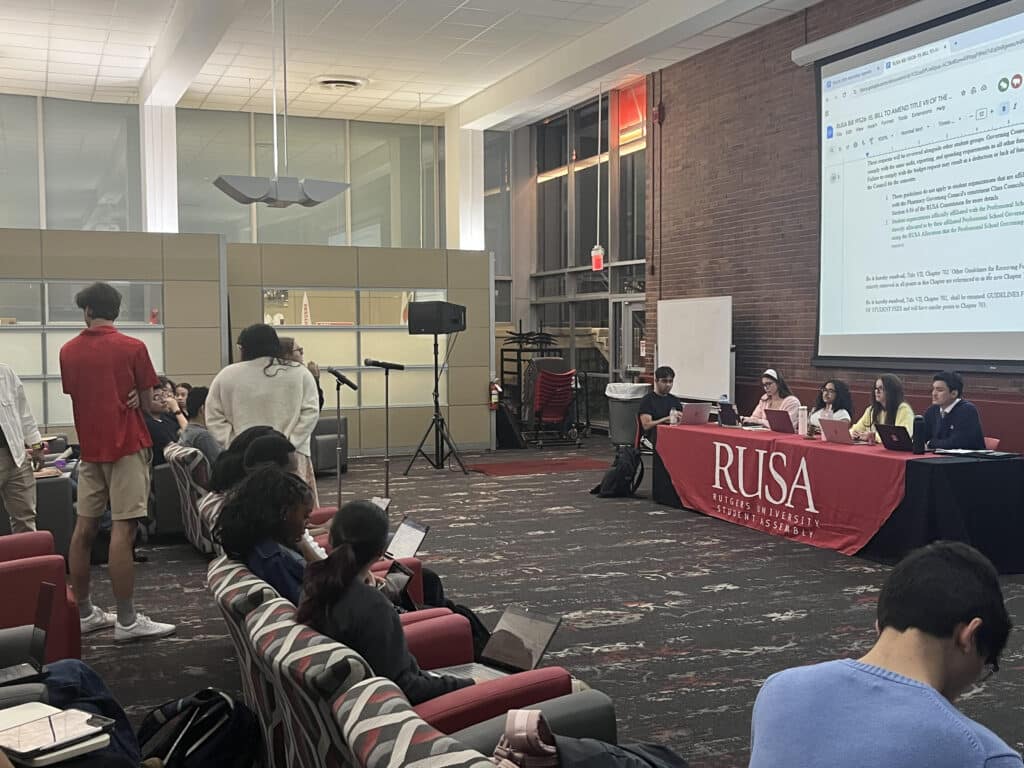
Photo: Andrew Hawthorne
RUSA leaders announced that the referendum to change the RUSA constitution failed to pass and a controversial bill changing student organization funding guidelines was rejected by the assembly at a meeting Thursday.
The assembly also passed a resolution voicing concerns about potential tuition, housing, and dining cost increases after the administration announced that classes will be cut and lecturers will be laid off due to budget cuts.
The assembly also heard two bills to change the standing rules regarding the powers of executive board members.
Multiple RUSA leaders also reminded attendees that voting for the 2026 RUSA general elections is open. All undergraduate students may vote in elections for RUSA President, Vice President, Treasurer, and multiple representative positions.
The form for undergraduate students to cast their vote can be found here.
Referendum fails
During the meeting, Parliamentarian Vinya Lingamneni announced that the referendum held two weeks ago failed to pass due to low voter turnout. The referendum failed to get at least 10% of the student body to cast their vote, as is required for a change to the constitution to pass.
If passed, the referendum would have updated outdated rules and language in the constitution to match current practices. It also would have decreased the ratio of campus representatives to students living on that campus, and added two new seats to the assembly with a School of Nursing representative and a School of Management representative.
Linganeni said the announcement was overdue, since voting closed before Spring Break. The official RUSA Instagram page also posted the results of the referendum for all students to see.
No plans to attempt the referendum or the constitutional changes were announced. However, some of the changes proposed by the referendum were featured in other bills presented at the same meeting.
Bill to changing funding guidelines fail
The assembly voted against passing a controversial bill to change the student organization funding guidelines that was presented at a meeting two weeks ago.
If passed, the bill would have changed the RUSA standing rules to make all student organizations follow RUSA guidelines, regardless of the governing body that directly allocated funds to that organization.
With the bill’s failure to pass, student organizations receiving funds from the governing councils of professional schools will only be subject to the guidelines of those governing councils.
The bill also would have created an auditing system for the RUSA Allocations Board to ensure that organizations are using funds correctly and required governing councils to submit detailed budget reports each semester, as governing council funds are controlled by the assembly.
Opponents of the bill, including multiple members of governing councils, argued that the bill would effectively remove the role of governing councils from the funding process.
School of Engineering representative Kelly Shapiro argued that governing councils have more knowledge on the specific needs of the organizations they fund, which would be lost if they did not have control of the guidelines in spending funds.
Presenters of the bill and members in favor of the changes said that the bill would make student organizations more equal and allow for more transparency in how student organization funds operate.
Some opponents of the bill said it went against the Transparency and Fairness for All Act, which was passed last year. TAFA aimed to ensure all allocated funds were being spent correctly, avoid conflicts of interests between governing bodies, and ensure the limited budget is allocated to the organizations who will spend it best.
While the changes introduced by TAFA do not relate to the controversial changes of the funding guidelines bill, TAFA redefines the relationship between the assembly and governing councils by stating that executive board members may not also be members of governing councils. TAFA also included a stipulation that the changes it introduces may not be changed until 2029.
Opponents of the funding guideline changes cited these restrictions to say the bill went against that TAFA stipulation by altering the relationship between RUSA and the governing councils before 2029.
RUSA President Christopher Godoy, an author of the bill, expressed frustrations with this reading of TAFA, even insinuating that opponents of the bill did not know how TAFA worked because they were not involved in creating it.
A reading of TAFA would suggest that the guideline changes do not break the 2029 stipulation, since it does not change any specific changes the act made.
The bill failed to reach a majority in the assembly to be passed. The exact vote count has yet to be made public.
Resolution on tuition prices passed
The resolution passed by the assembly expresses concerns about potential increased costs as the University Board of Governors are expected to decide on tuition, fees, housing costs and dining costs for next semester at a meeting Tuesday.
This comes as administration announced course cancellations in the School of Arts and Sciences and layoffs for 38 lecturers who won’t be returning in the fall.
The resolution asks the Board of Governors to be transparent in their decision-making, seek out student input on those changes and consider expanding financial aid programs to aid students who may not be able to afford the increased costs.
The resolution also reaffirms the assembly’s responsibility to represent student voices on issues like student costs.
Godoy also encouraged attendees to attend the meeting virtually, as well as to submit questions and concerns so that they may be reviewed by the Board of Governors during the meeting.
Bills to change standing rules presented
The assembly heard two bills to change the RUSA standing rules. Both bills aim to clear up vague language in the RUSA standing rules.
One of the bills defines the powers and adds responsibilities of executive board members.
If passed, all members of the executive board would be required to give updates at meetings regularly.
The bill would also require the president to meet with governing councils once a semester and ask executive board members to be involved with relevant initiatives before the president chooses to lead an initiative themselves.
The RUSA secretary would be required to communicate with outgoing members of the executive board to allow for smooth transitions of power. The secretary would also have to keep records of the assembly’s communications with groups outside of RUSA, such as brands and alumni.
The bill would eliminate the positions of Assistant Secretary for Records and Assistant Secretary for Technology, which have gone unappointed for multiple assemblies.
The bill would also clarify an eligibility requirement for RUSA president that states a candidate must have at least one year experience in RUSA. If passed, candidates for president must have attended at least 60% of meetings of the previous assembly. This requirement was originally in the failed constitutional referendum.
The bill would also change the name of the Big Ten Liasson position to “Intercollegiate Liasson.”
The other bill changes the standing rules regarding the Judicial council and Parliamentarian.
If passed, the bill would reinforce a requirement for Judicial council members to attend at least one weekly meeting.
The bill also resolves two conflicting parts of the standing rules regarding the interpretation of student organization guidelines. If passed, the Parliamentarian and the Allocations Board would have equal say in interpreting those guidelines, with any conflicts between the two immediately brought before the Judicial Council.
Votes on both standing rules bills will be held at a meeting next week.
Other meeting details
Sexual Violence Education Chair Destiny Rosales announced that the “Birdie” personal safety devices funded last semester have arrived and will be distributed around starting next week. She welcomed anyone to reach out to ensure they get a device before they run out.
University Affairs Chair and RUSA presidential candidate Alina Chen announced that meal swipe options are coming soon to the Civic Square Building, the location of the Bloustein School of Planning and Public Policy.
During public comment, Deputy Chief of Staff to the Vice President Devon Davis expressed frustrations with the assembly’s difficulty returning to order after disruptions and recesses. Davis demanded that assembly members take their seats and stop side-conversations at the request of Vice President Lily Sousa so meetings do not need to last as long as they often do.
The next meeting on Thursday, April 2 will be the last legislative meeting of the current RUSA assembly.
For the full meeting minutes for the March 26 meeting can be found here.
Noah Choi contributed to this report.